What is Basis? Perp-Spot Spread Mechanics
The basis in crypto is the difference between the perpetual futures (perp) price and the spot price of the same underlying asset, usually expressed as a percentage: Basis = (Perp Price – Spot Price) / Spot Price. When the perp trades above spot—a common state in bull markets—the basis is positive. When it trades below, the basis is negative. This spread exists because perpetual futures use a funding rate mechanism to tether the contract price to the spot index.
Every funding interval (typically every 8 hours on major exchanges) the contract pays a fee from one side to the other. If the perp price is higher than the spot, longs pay shorts a funding fee proportional to the premium. Conversely, if the perp is cheaper, shorts pay longs. This flow incentivizes arbitrageurs to step in and bring the perp price back towards spot. For example, if the basis is large and positive, a trader can short the perp, buy the spot, and collect funding payments while remaining market‑neutral.
Measuring the Basis and Annualised Funding Rate
Because funding cycles are short (8 hours), converting the per‑interval rate to an annualised figure helps compare it with other yields. The formula: Annualised Funding Rate = Funding Rate per Interval × Number of Intervals per Year. Crypto perpetuals fund 3 times daily (1 095 intervals/year). So a 0.03% per‑8h rate equals roughly 32.85% APR. Traders tracking basis use this annualised metric to decide whether executing a basis trade is worthwhile after costs.
The basis itself can be decomposed into the expected funding over the next several cycles. Sophisticated traders watch the premium index (the moving average of the perp‑spot spread) and the funding rate prediction to gauge whether the basis is stable or likely to shrink.
Why Basis Widens: Leverage, Speculation, and Risk Premium
Perpetual futures prices deviate from spot mainly because of leveraged demand imbalance. In bull markets, traders overwhelmingly open long positions, pushing perp prices above spot as they are willing to pay a premium for synthetic leverage. This creates a positive basis and a steady funding stream from longs to shorts. The wider the basis, the more aggressive the speculation. High open interest and rising leverage ratios (often visible on‑chain) frequently coincide with a blown‑out basis.
Conversely, during panics or prolonged bear trends, short demand can force perps to trade at a discount, causing negative funding. Then the basis trade flips: you would short spot (if feasible) and go long perps to collect funding from the shorts. But in practice, borrowing spot to short is expensive, so most traders focus on the classic long‑spot/short‑perp leg when funding is positive.
Market fragmentation also causes basis disparities. One exchange may show a 50% annualised basis while another sits at 20% simply because of its user base’s risk appetite. Professional desks exploit these gaps with cross‑venue arbitrage, but the pure basis trade on a single venue still benefits from a wide local spread.
To add conviction to a basis entry, many traders use composite signals that blend derivatives data with on‑chain whale activity. The Smart Money API heatmap is one such tool—it aggregates derivatives scores, 1 500+ whale wallets, and macro metrics into a single trade‑confirmation score. When the basis starts to widen and the API returns a HIGH confidence reading, the trade setup becomes far more compelling.
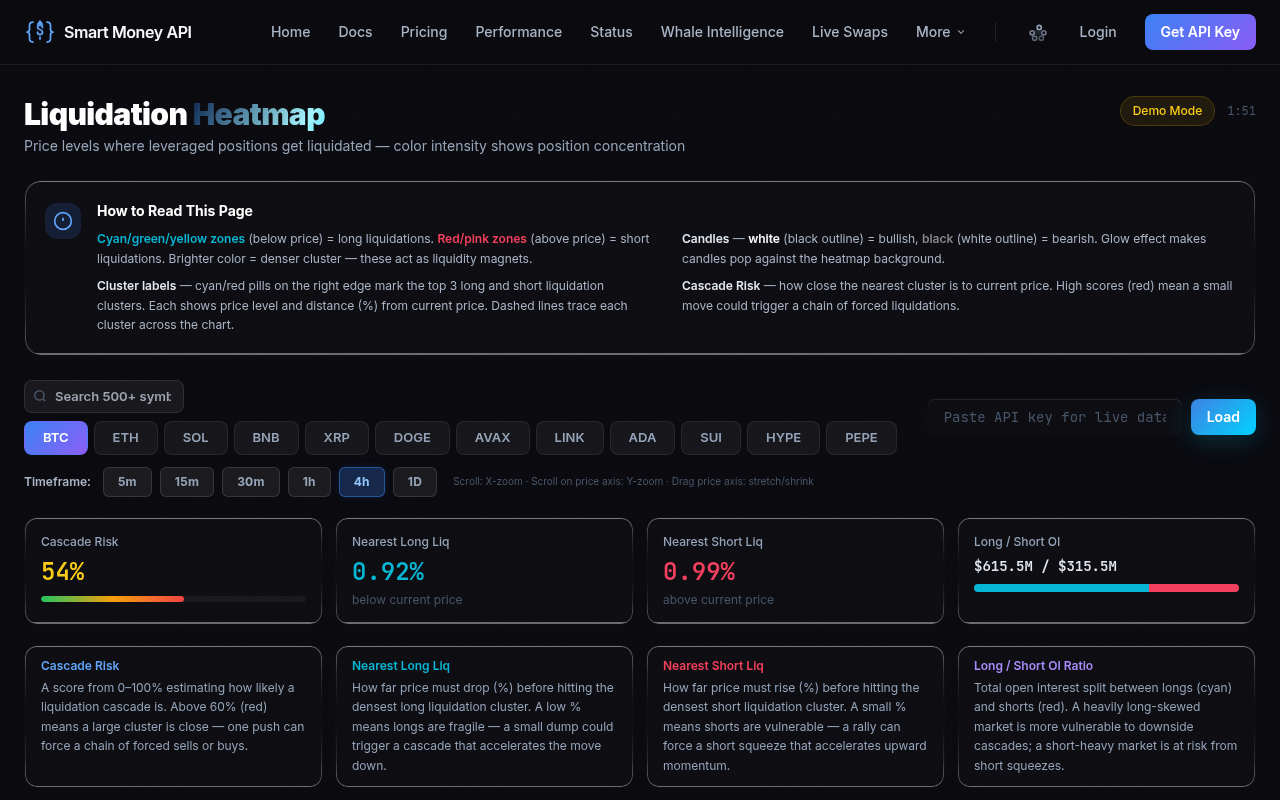
For instance, a query for a long bias during a positive‑basis regime might look like this:
GET /v1/confirm?symbol=BTC&direction=long
{
  "composite": 0.74,
  "confidence": "HIGH",
  "action": "CONFIRM",
  "size_mult": 1.5,
  "deriv_score": 0.81,
  "onchain_score": 0.68,
  "whale_score": 0.73
}
A high deriv_score paired with a supportive on‑chain and whale score suggests the basis is underpinned by genuine market structure, not just fleeting speculation. This helps avoid entering a trade just before the spread collapses—a common pitfall.
The Basis Trade: Long Spot + Short Perps + Harvest Funding
At its core, the basis trade exploits the funding rate while staying delta‑neutral. The classic setup involves two simultaneous actions:
- Buy the spot asset – acquire the underlying crypto on a spot market.
- Short an equal notional amount of perpetual futures – sell the perp contract on a derivatives exchange.
Because the perp and spot prices move almost 1:1, any gain on the spot leg is offset by a loss on the futures leg, and vice versa. The portfolio’s value remains roughly constant except for the funding payments received (or paid). If the basis is positive, the short perp position earns funding from the longs every 8 hours. That funding is the trader’s profit, less costs.
Step‑by‑Step Execution
- Select a pair (e.g., BTC‑USD) with a large, stable positive annualised basis.
- Decide on notional size. For instance, $50 000.
- Buy spot: place a limit order to acquire the exact amount (0.83 BTC at $60k, or use full amount).
- Simultaneously short the equivalent perp notional. On Binance, a BTC perpetual contract has a face value of 1 USD, so you would open a short position of 50 000 contracts (notional $50 000).
- Holding: every 8‑hour funding window, the exchange credits funds to your futures wallet. Withdraw these profits periodically to stablecoins to avoid inadvertently expanding the spot leg.
- Exit: when the basis compresses, unpairs move, or funding turns negative, close both legs at the same time to lock in the accumulated yield.
Profit Breakdown Example
Assume ETH spot = $2 500, perp = $2 515 (basis +0.6%), 8‑hour funding = 0.06% (65.7% APR). You deploy $50 000, buying 20 ETH spot and shorting 20 ETH worth of perps ($50 000 notional). Daily funding per interval = $50 000 × 0.06% = $30. Over 30 days, assuming stable funding, you collect $900 (1.8% monthly, 21.6% annualised). Deduct spot taker fee ($25) and perp taker fee ($15), net $860. If you had held spot with no hedge, you would have faced 20‑30% drawdown risk; here you earn a clean yield. The actual profit is Funding received − (Trading fees + Opportunity cost of capital). Using borrowed stablecoins or idle capital further changes the calculus. A tool like Smart Money API can alert you when funding rates begin to decline sharply, signalling it’s time to close the basis trade early.
Exchange Selection: Which Venues Have Liquidity Spreads
Not all exchanges price perpetuals identically. Differences in trainee demographics, market‑maker activity, and insurance fund mechanics lead to varying basis levels. A disciplined basis trader monitors several venues to pick the most lucrative spread.
| Exchange | Typical BTC Funding Rate (8h) | Annualised Basis Range | 24h Perp Volume (approx.) | Taker Fee |
|---|---|---|---|---|
| Binance | 0.01% – 0.15% | 11% – 164% | $12B+ | 0.04% |
| Bybit | 0.01% – 0.10% | 11% – 109% | $5B+ | 0.06% |
| OKX | 0.01% – 0.12% | 11% – 131% | $4B+ | 0.05% |
| Deribit | 0.005% – 0.07% | 5.5% – 77% | $1.5B+ | 0.05% |
Rates are illustrative and change rapidly. Always check live data before trading.
Liquidity matters profoundly. A thin order book can cause slippage that eats several funding cycles’ worth of profit. Concentrating the trade on a single liquid exchange avoids cross‑venue basis risk and withdrawal delays. For instance, if you short the perp on Binance but hold the spot on a smaller exchange, a flash crash in one market could briefly break the peg, leading to margin calls or forced liquidation. Keeping both legs on the same platform (or using a platform with deep integrated spot‑perpetual liquidity) simplifies risk management.
Decentralised perp platforms like dYdX or GMX offer algorithmically set funding rates that can occasionally diverge from CEX rates. While they offer non‑custodial security, the spot leg is trickier to execute on‑chain without bridging costs. For most retail and professional traders, the CeFi route remains the most capital‑efficient.
Position Sizing: Matching Leverage on Spot and Futures
Delta neutrality is the trade’s bedrock. The notional value of your spot holding must equal the notional value of your perp short. If you buy 1 BTC spot outright, you should be short exactly 1 BTC worth of perpetual contracts. Any mismatch introduces directional exposure and can quickly turn a supposedly market‑neutral yield play into a speculative bet.
To get the contract sizing right, use a futures calculator. For example, on Bybit the BTC perpetual is quoted in USD and has a contract size of 1 USD. To short 1 BTC at $60 000, you need a position of 60 000 contracts. The calculator shows the margin required and the liquidation price. Because the spot leg acts as full collateral, you can often choose 1x leverage on the futures side to avoid liquidation risk entirely.
Capital Efficiency with Partial Leverage
Suppose you have $100 000 in capital. Instead of locking all of it into spot, you can buy $60 000 of BTC spot, then use the remaining $40 000 as margin for the perp short with 1.5x leverage (short notional still $60 000). This unlocks $40 000 for other yield strategies—lending, staking, or running a second basis trade on a different pair. However, using leverage on the spot leg (through margin spot trading) introduces borrowing costs that must be subtracted from the funding yield. The pure form keeps the spot leg fully funded with own capital, making funding the only net variable.
For traders looking to gradually build the spot position to avoid slippage, the DCA bot calculator from CryptoCalcs helps simulate dollar‑cost averaging into the spot asset over a predefined period, smoothing out the entry price and reducing market impact. This is especially useful for large notional amounts that could move thin books.
Managing Slippage, Fees, and Rebalancing Drift
Execution quality separates profitable basis trades from breakeven ones. Entering a large spot order at market can instantly pay away 0.1–0.3% in slippage. Perpetual futures often have deeper books, but hitting the spread on both sides simultaneously can still cost several funding cycles. The ideal approach is to split the order into smaller chunks using a TWAP algorithm or to patiently place limit orders on both legs near the mid‑price. Some exchanges offer maker rebates if you add liquidity; capturing a 0.02% rebate on both sides effectively pays for a portion of the expected funding.
Fee Management
Typical costs include:
- Spot taker fee (0.1%–0.2%)
- Perp taker fee (0.04%–0.06%)
- Funding rate fee (no direct fee, but you collect less if the perp price converges intra‑cycle)
- Withdrawal fees when moving profits out
For a basis trade lasting weeks, these fixed costs should represent a tiny fraction of the accumulated funding. A trade that yields 30% APR can withstand 0.5% in total entry/exit costs. Still, keeping fees low by using limit orders and choosing exchanges with competitive fee tiers is essential.
Rebalancing Drift
Because the futures contract tracks the spot price closely, the delta‑hedge does not decay due to price moves alone. If you bought 1 BTC and shorted 1 BTC perp, after a 10% rally both legs are still 1 BTC in size, and the P&L cancels out. The only drift comes from reinvesting funding profits into the spot leg—which would increase the spot notional relative to the short—or from paying funding in a negative regime. To maintain absolute neutrality, sweep funding proceeds into a stablecoin and do not use them to buy more spot. Alternatively, if you wish to compound, adjust the perp short size accordingly after each funding event. Many traders automate this with a simple script that reads wallet balances and submits an adjust‑position API call.
Advanced: Multi‑Leg Basis (Spot + Staking + Lending)
Stacking multiple yield sources on top of the basis converts a solid trade into a high‑performance carry strategy. Since you already hold the spot asset, you can put it to work while it sits idle:
- Staking derivatives: Buy stETH instead of bare ETH. stETH accrues staking rewards (~3‑5% APR) and can be used as spot collateral on some exchanges. You then short the ETH perp. The net yield becomes funding rate + staking yield. The risk: stETH trades at a slight discount/premium to ETH, which can introduce a small basis gamble. Monitoring the stETH/ETH peg is mandatory.
- Lending pools: Deposit spot assets into CeFi Earn (e.g., Binance Simple Earn) or DeFi lending markets like Aave. You earn lending APR while still holding the asset; when it’s time to exit, you withdraw and sell. Some exchanges allow “portfolio margin” where spot assets in Earn count as collateral for futures, simplifying the operational side.
- Synthetic basis trades: Borrow the asset from a lending protocol, sell it spot, and simultaneously short the perp. This creates a net short position on the spot leg but neutral overall when combined with the perp hedge. The profit is: funding received + (lending yield on the borrowed asset after selling it minus borrow interest). This is highly capital‑efficient but demands careful health‑factor tracking.
When layering yields, verify that the additional return justifies the added complexity and smart‑contract risk. A conservative basis trade that yields 25% APR with minimal moving parts is often superior to a 35% yield with a labyrinth of smart‑contract dependencies and potential oracle failures.
The Smart Money API can serve as a decision filter for these advanced overlays. Its composite score, drawn from derivatives tension, whale accumulation, and on‑chain flows, can signal when the broader market is shifting, prompting you to unwind the entire structure before basis compression or a DeFi exploit erodes profits.
Conclusion: Building a Systematic Basis Trading Edge
Basis trading remains one of the most dependable yield strategies in crypto, precisely because it monetises market inefficiencies rather than predicting price direction. By going long spot and short perpetuals when the funding rate is highly positive, you earn a stream of payments that often dwarfs traditional fixed‑income returns. The key is to remain rigorously delta‑neutral, select exchanges with deep liquidity and favourable fees, and diligently manage slippage and reinvestment drift. Tools like the CryptoCalcs futures calculator and DCA bot calculator help size positions accurately, while the Smart Money API heatmap provides a composite market view to time entries and exits. To gain a real‑time edge with institutional‑grade trade‑confirmation scores—including derivatives, on‑chain, and whale wallet intelligence—sign up for a free API key at smartmoneyapi.com/signup and elevate your arbitrage game.