Choosing an Exchange API
Native REST vs. WebSocket Feeds
Every automated trading system begins with a reliable exchange connection. Most crypto exchanges offer both REST endpoints and WebSocket streams. REST APIs are stateless and allow your bot to fetch order books, account balances, and execute trades on demand. They are simple to implement but introduce latency because each request opens a new HTTP connection. WebSocket feeds, on the other hand, maintain a persistent connection and push real‑time market data directly to your bot. For a bot that relies on instantaneous signal confirmation, WebSocket updates for order book depth and ticker prices are mandatory. You can still use REST for account actions and order placement, but the core price feed must be low‑latency to avoid slippage between a confirmation signal and execution.
Rate limits differ markedly between exchanges. Binance allows up to 1200 weight units per minute on its REST API, while Bybit’s WebSocket channels permit up to 50 subscriptions per connection. When sketching your architecture, calculate the total number of symbols and data streams you intend to monitor. A single bot that trades BTC and ETH perpetual swaps might need 10 separate WebSocket streams (order book, trades, funding rate, mark price). Some exchanges throttle REST endpoints to 10 requests per second, which can delay order placement if your bot suddenly triggers multiple trades across symbols. Always implement a token‑bucket or sliding‑window rate limiter in your code to stay compliant and avoid bans.
Which Exchanges Support Advanced Order Types
A confirmation‑based strategy often requires more than simple market orders. Stop‑limit, trailing stop, and reduce‑only orders help execute precisely when a composite signal flips. For instance, if your confirmation engine signals a long entry with a confidence of HIGH, you might want to place a limit order at a specific offset from the current price to capture the move without paying taker fees. Not every exchange supports the same advanced order types. Binance’s perpetual futures (USDⓈ‑M) support both stop‑market and stop‑limit orders with a working type of “MARK_PRICE” or “CONTRACT_PRICE”. Bybit offers conditional orders and a unique “Post‑Only” flag to ensure you remain a maker. When choosing an exchange, verify that its API documentation lists the order types you need: bracket orders, OCO (One‑Cancels‑the‑Other), and reduce‑only flags are particularly useful for multi‑legged positions that depend on confirmation strength.
Rate Limits and API Key Security
Security is non‑negotiable. Generate API keys with the minimum permissions required: enable trading and reading, but disable withdrawals. Use IP whitelisting if your bot runs on a fixed cloud server. Never store secret keys in plain text inside your source code; use environment variables or a vault service. For high‑frequency confirmation systems, consider spreading load across multiple API key pairs to avoid hitting individual key rate limits. Some exchanges (like Binance) allow you to create up to 30 API keys per sub‑account, each with independent rate limits. In addition, monitor the exchange’s status page via a separate health‑check endpoint so your bot can gracefully pause trading during maintenance windows.
Designing Your Bot Architecture
Event‑Driven Loop with Signal Queue
A robust crypto trading bot follows an event‑driven design. Instead of polling every data source sequentially, set up an asynchronous event loop that listens to multiple WebSocket streams and REST callbacks concurrently. Each tick of new market data, on‑chain transaction, or news headline becomes an event that enters a central signal queue. A dedicated consumer thread then pulls events, timestamps them, and feeds them into your confirmation engine. This keeps latency minimal and prevents one slow data source from delaying the entire pipeline. In Python, the asyncio library combined with websockets is a popular stack; in Node.js, ws and events modules serve the same purpose.
State Management and Position Tracking
Your bot must maintain an accurate internal state of current positions, open orders, and pending signals. A simple dictionary or in‑memory data structure works for single‑instance bots, but once you scale to multiple trading pairs, a lightweight database like SQLite or Redis becomes essential. State management should record the entry price, timestamp, position size, and the confirmation score that triggered the trade. This historical ledger enables you to later evaluate whether high‑confidence signals truly outperform lower‑confidence ones. When a new confirmation signal arrives, the engine must first check whether an existing position in the same direction already exists. If a conflicting signal arises (e.g., short while holding long), your predetermined rules must handle it — either by closing the existing position, reducing size, or ignoring the signal based on the new confidence level.
Modularizing the Confirmation Layer
The most critical component is the confirmation layer itself, which fuses multiple data signals into a single actionable score. Instead of hard‑coding dozens of individual checks, decouple your data fetchers from the scoring logic. Each data source — derivatives, on‑chain, whale wallets, sentiment — should return a normalized score between 0 and 1, representing the strength of the directional signal. The confirmation engine then applies a weighted sum (or a machine‑learning model) to compute a composite score. For traders who want to skip the heavy lifting of aggregating and weighting raw data, specialized services exist. One standout is Smart Money API, which fuses derivatives activity, on‑chain flows, over 1,500 whale wallets, and macro/news sentiment into a single trade‑confirmation score. With a documented 62% win rate on its HIGH signals and a free tier, it allows developers to instantly integrate a production‑grade composite signal without building the entire pipeline from scratch.
Fetching Funding Rates & Long/Short Data
Interpreting Perpetual Swap Funding
Perpetual futures funding rates are a direct window into market sentiment. Exchanges compute funding every 8 hours (or continuously) based on the premium between the perpetual contract price and the spot index. When funding is positive, longs pay shorts – indicating bullish crowding and a possible overheating. When negative, shorts pay longs, often preceding bounces. Your bot should collect funding rate data for the target symbol across multiple exchanges because the aggregate funding premium can reveal divergences. For example, if Binance and Bybit show highly positive funding but OKX is neutral, a composite funding score can be calculated by averaging normalized values across exchanges. A common rule: if the composite funding rate exceeds 0.1% per 8‑hour period, it produces a bearish override signal, reducing the long confirmation score. Conversely, deeply negative funding (below –0.1%) boosts a long signal.
Open Interest and Long/Short Ratios
Open interest (OI) changes depict whether money is flowing into or out of a market. A rising OI alongside rising price confirms a strong trend; rising OI with falling price suggests short‑side accumulation. Exchanges like Binance provide long/short ratio data derived from top trader accounts. Integrating this into your bot means calling the respective endpoints every few minutes and computing the delta. A typical approach: fetch the current OI and compare it with the 24‑hour change in OI. If OI is increasing while price is also climbing, assign a positive score to the long signal. If OI is dropping during a rally, it may be a trap — the confirmation engine should lower the composite score. Long/short ratios above 2.5 or below 0.4 often act as contrarian indicators; many quants invert the ratio to generate a mean‑reversion score.
Storing and Cleaning Derivatives Data
Derivatives endpoints return JSON payloads that often need normalization. Timestamps may be in milliseconds, and funding rates are expressed as floating‑point percentages. Store each data point with the exchange name, symbol, timestamp, and value in a time‑series database (InfluxDB or TimescaleDB). This allows your backtester to replay historical conditions accurately. Before using any value in your confirmation engine, run a basic sanity check: reject extreme outliers (funding rates > 5% or OI spikes of 500% in one hour) that likely stem from API glitches. A moving average filter on the raw funding rate can smooth noise and prevent over‑reaction.
Integrating On-Chain Data Streams
Exchange Netflows and Reserve Data
On‑chain metrics offer a fundamental layer that purely technical bot strategies miss. Exchange netflow — the difference between coins flowing into exchange wallets and those leaving — is a powerful signal. A large positive netflow suggests investors are moving assets to exchanges, possibly to sell. A negative netflow means coins are being withdrawn to cold storage, a bullish accumulation signal. Your bot can subscribe to a WebSocket stream from a blockchain data provider such as Glassnode or CryptoQuant, or poll REST endpoints that aggregate netflows for major exchanges. When building your confirmation engine, convert the 24‑hour netflow into a z‑score relative to its 30‑day mean. A z‑score below –1.5 (heavy outflows) adds weight to a long signal; above +1.5 favours shorts.
Network Value to Transactions (NVT) and Active Addresses
NVT, akin to a P/E ratio, divides network value by daily transaction volume. An NVT above 95 historically signals overvaluation; below 50 indicates undervaluation. Meanwhile, the number of active addresses reflects user engagement. A rising price with declining active addresses is a bearish divergence. To integrate these, set up a daily cron job that queries a blockchain explorer API (e.g., Etherscan for ETH, blockchain.com for BTC) and computes the NVT ratio. Because on‑chain data is slower than tick data, you can assign it a lower weight in the composite score but use it as a regime filter: for example, if NVT > 100, the bot may only take short confirmations, ignoring long signals entirely.
Using Web3 Providers vs. Aggregators
Directly connecting to a node (via Infura, Alchemy, or QuickNode) gives you raw block data, but parsing every transaction for netflow calculations is resource‑intensive. Most developers prefer aggregator APIs that pre‑compute metrics. The table below compares common on‑chain data sources.
| Data Source | Latency | Coverage | Cost |
|---|---|---|---|
| Self‑hosted node | Real‑time | Full blockchain | High (infra) |
| Glassnode Studio | ~5 min | BTC, ETH, and major tokens | $$$ (paid tiers) |
| CryptoQuant | ~1 min | Exchange‑focused metrics | $$ |
| Dune Analytics (query engine) | ~15 min | Custom SQL over decoded contracts | Free / Pro |
| Smart Money API (on‑chain module) | Real‑time | BTC, ETH, top altcoins | Free tier available |
For a trading bot that needs sub‑minute updates, real‑time aggregators are ideal. Smart Money API’s on‑chain module, for instance, normalises netflow, reserve, and active address data into a single onchain_score from 0 to 1, removing the need to maintain your own node.
Whale Movement Detection
Tracking Large Transactions in Real Time
Whale movements — transfers exceeding $1 million in BTC or $500k in ETH — can foreshadow major price swings. Services like Whale Alert and blockchain explorers provide APIs that stream large transactions. Your bot can subscribe to these feeds and filter transactions involving exchange deposit addresses. A sudden influx of 10,000 ETH to Binance may precede a sell‑off. To integrate whale data, maintain a dictionary of known exchange deposit wallets (publicly available lists) and cross‑reference each incoming transaction. If a whale deposit is detected, generate a short‑biased override with a configurable time decay — the signal’s influence should fade over 30 minutes unless followed by additional deposits.
Historical Accumulation/Distribution Patterns
Not every whale move is a trade signal. Many are internal exchange reshuffles or cold‑wallet consolidations. That’s why historical pattern analysis matters. Track the cumulative balance of whale addresses (top 1,000 wallets) over time. When large wallets consistently accumulate during a dip and the 30‑day accumulation score exceeds a threshold, it’s a strong long confirmation booster. The Smart Money API already tracks over 1,500 whale wallets and outputs a whale_score that aggregates accumulation vs. distribution signals, allowing your bot to simply consume a pre‑computed value.
Filtering Noise from True Whale Activity
False positives are the enemy. A single 100 BTC move to a hot wallet may be an exchange migrating funds, not a bearish signal. Implement filters: ignore transactions between known exchange‑owned wallets, ignore transfers smaller than a dynamic threshold (e.g., 500 BTC for Bitcoin), and require at least two large inflows within a 10‑minute window before triggering a signal. A more sophisticated bot uses a machine‑learning classifier trained on historical whale behaviour to label moves as “accumulation”, “distribution”, or “noise”. However, for most retail developers, using a curated whale movement API that already applies these filters saves months of development.
News & Sentiment Data Sources
NLP and Social Media Scanning
Sentiment derived from news headlines, Twitter, and Reddit can move crypto markets within minutes. Your bot can consume streaming APIs like NewsAPI, CryptoPanic, or LunarCrush to fetch real‑time headlines. However, processing raw text requires natural language processing (NLP). A common pipeline: use a pre‑trained model (e.g., FinBERT or a Crypto‑specific BERT variant) to score each headline from –1 (bearish) to +1 (bullish). Then aggregate scores over a one‑hour rolling window. A sudden spike in negative sentiment combined with a certain deviation can act as a strong confirmation for a short entry. Be mindful of rate limits; many news APIs restrict free tiers to 100 requests per day, so batch processing every 5 minutes is acceptable.
Event‑Driven Volatility Signals
Macro economic events — FOMC minutes, CPI releases, regulatory announcements — inject volatility that technical indicators cannot predict. Your bot should maintain an economic calendar via a service like ForexFactory or an API that lists upcoming high‑impact events. One hour before a known event, the confirmation engine can temporarily widen its confidence thresholds or pause trading entirely. Alternatively, if the event aligns with your direction (e.g., a dovish Fed statement while holding a long confirmation), the bot can increase position size slightly, but only with a strict stop‑loss. This type of macro overlay often determines whether a composite signal holds through the noise.
Combining Headlines with Market Reaction
Mere news is not enough; the market’s immediate reaction matters more. A headline that reads “SEC sues exchange X” combined with a rapid 3% price drop in BTC solidifies the short bias. Your bot can measure the velocity of price change in the seconds following a high‑impact news release and convert that into a momentum score. For instance, if BTC drops 2% within 2 minutes of a negative headline, override all long signals for the next hour. Services like Smart Money API incorporate macro and news sentiment into their composite score, but if you build your own layer, be sure to correlate news timestamp with price ticks precisely to avoid lag.
Building the Confirmation Engine
Weighting and Scoring System
The core of a confirmation bot is the scoring algorithm. Each data layer — derivatives, on‑chain, whale, and sentiment — returns a normalised directional score. For a long signal, you want the score to reflect bullish conviction. A simple weighted average does the job: composite = w1*deriv_score + w2*onchain_score + w3*whale_score + w4*sentiment_score. Assign initial weights based on backtested importance (e.g., 0.35 to derivatives, 0.25 to on‑chain, 0.25 to whale, 0.15 to sentiment) and then optimise them later. The engine must also check for minimum coverage: if any score is missing (e.g., on‑chain data stream is down), reduce the composite or discard the signal entirely. A production‑ready confirmation layer handles incomplete data gracefully by using cached values for a few minutes before staling out.
Thresholds for Signal Confirmation (HIGH / MEDIUM / LOW)
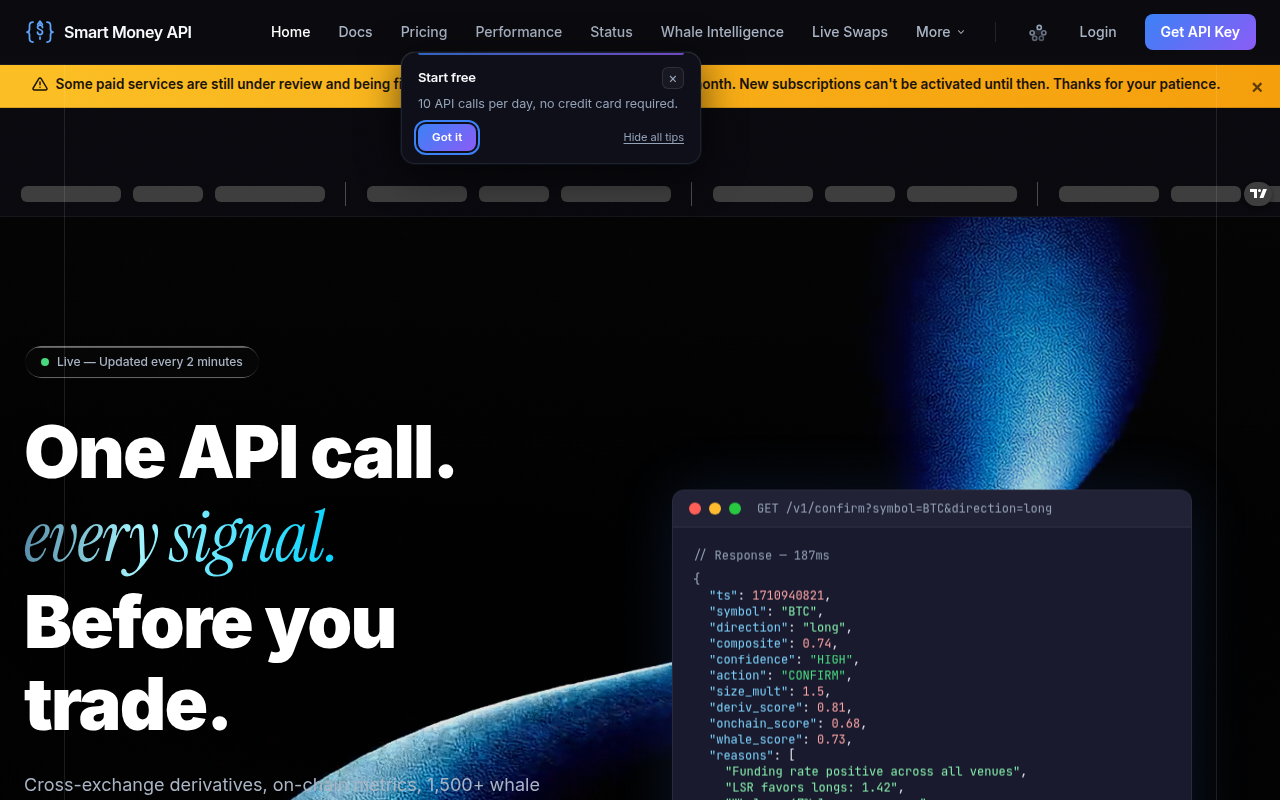
Once the composite score is computed, map it to a confidence band. For example, a composite ≥ 0.75 → “HIGH” confidence, triggering a trade with full position size and perhaps a multiplier. Between 0.5 and 0.75 → “MEDIUM” – take the trade at half size. Below 0.5 → “LOW” – do not trade, or only paper trade. The bands must be strict; many profitable bots achieve a 60%+ win rate only on HIGH signals. Smart Money API’s endpoint does exactly this: it returns a composite score with a confidence field (HIGH, MEDIUM, LOW) and a recommended size multiplier. Here’s how a live API call looks:
GET /v1/confirm?symbol=BTC&direction=long
{
  "composite": 0.74,
  "confidence": "HIGH",
  "action": "CONFIRM",
  "size_mult": 1.5,
  "deriv_score": 0.81,
  "onchain_score": 0.68,
  "whale_score": 0.73
}
With this payload, your bot can instantly decide to enter a long BTC position at 1.5× the base size, because the composite score exceeds the HIGH threshold (0.70 in this case) and the action is “CONFIRM”. The breakdown reveals that derivatives and whale activity are both bullish, overwhelming a slightly neutral on‑chain score.
Handling Conflicting Signals
Converse signals require special logic. If the derivatives layer screams “long” (deriv_score > 0.8) but on‑chain data is deeply bearish (onchain_score < 0.3), a simple average might still produce a medium score, but it hides the conflict. Implement a disagreement penalty: if any pair of scores diverge by more than 0.4, reduce the composite by 0.2 or drop the confidence by one level. Some engines use a unanimity rule — only act when at least three out of four layers agree within a defined tolerance. This filtering dramatically increases signal quality, though it reduces trade frequency. During backtesting, you’ll find the optimal balance.
Backtesting & Parameter Optimization
Simulating Historical Data Feeds
A multi‑factor bot demands realistic backtesting. You cannot simply test on OHLCV candles because your signals depend on funding rates, on‑chain netflows, and sentiment that change at different frequencies. Use a backtesting framework (Backtrader, Zipline, or a custom event loop) that replays a sequence of timestamped events. Gather historical funding rate data from exchanges’ public archives, on‑chain metrics from a blockchain data provider, and sentiment scores from a NLP service’s historical output. Align all data streams to the same UTC timestamp. Then simulate the confirmation engine exactly as it would run live, applying the same weighting and threshold logic.
Walk-Forward Analysis and Overfitting Prevention
Crypto markets are non‑stationary; parameters optimised on a 2023 dataset may fail in 2024. Perform walk‑forward analysis: split your data into in‑sample (e.g., Jan‑Jun 2023) and out‑of‑sample (Jul‑Dec 2023) periods. Optimise weights on the in‑sample period, then test on the out‑of‑sample without re‑optimising. Repeat sliding windows to ensure robustness. Keep the number of tunable parameters minimal (weights, thresholds, penalty magnitude). A complex model with dozens of parameters will overfit easily. Logistic regression or a simple neural network can replace the weighted sum, but only if you have enough data. Most retail traders find that a well‑tuned linear weight system, similar to the one Smart Money API employs, performs surprisingly well.
Tuning Weights per Market Regime
Different market regimes favour different signal types. In a trending bull market, derivatives and whale accumulation dominate. In a range‑bound market, on‑chain netflows and sentiment become more predictive. Segment your backtest into regimes (using an indicator like ADX or a simple volatility measure) and derive separate weight sets. When live trading, your bot can detect the current regime by monitoring realised volatility and switch the weight configuration on the fly. This dynamic adaptation increases the composite signal’s accuracy across all conditions.
Live Trading Risk Controls
Position Sizing with Confirmation Strength
The confidence level directly dictates position size. If the composite score yields a HIGH signal with a size multiplier of 1.5, risk 1.5% of equity rather than the standard 1%. Use a dedicated position size calculator to compute contract quantity based on account balance, stop‑loss distance, and risk percentage. For multi‑layer confirmation, the advanced position calculator lets you input the confidence score directly and automatically adjust the lot size. This ensures that stronger confirmations receive more capital, while weaker ones are downsized, naturally skewing your risk‑reward ratio in your favour.
Circuit Breakers and Kill Switches
No bot is infallible. Implement circuit breakers that pause trading if the bot loses more than X% of equity in a day, or if the exchange reports insufficient margin. A global kill switch, triggered by a simple REST call or manual UI button, should cancel all open orders and flatten positions. Monitor the health of each data source: if the confirmation engine suddenly receives no whale data for 5 minutes, it could generate false alarms. Program a watchdog timer that halts trading when any critical feed is stale.
Monitoring and Logging
Log every signal evaluation, trade execution, and state change to a persistent store. Include the raw scores, composite, confidence, and the final action taken. Later analysis of these logs will reveal whether your HIGH signals truly outperform, and whether disagreements between layers caused missed opportunities or drawdowns. Set up real‑time alerts (Telegram bot, email) for critical events: HIGH signal on a top‑5 coin, exchange errors, or abnormal slippage. Continuous monitoring lets you iteratively refine the confirmation engine without guesswork.
Strengthen Your Bot with a Ready‑to‑Use Confirmation Layer
Building a composite confirmation engine from scratch is an ambitious project that requires stitching together multiple data streams, normalising scores, and continuously optimising weights. For traders who want to shorten the development cycle and tap into a proven signal with a 62% win rate, sign up for Smart Money API to get a free API key. Its unified endpoint delivers the composite confirmation score, confidence level, and size multiplier with a single call, so you can focus on execution and risk management. Whether you code a custom engine or leverage a pre‑built solution, the era of single‑indicator bots is over — layered confirmation is the key to algorithmic consistency.