Exchange-Native APIs: Binance, Coinbase, Kraken, Bybit
Choosing the right API starts with understanding the native offerings of the world’s biggest exchanges. Each provides a unique blend of liquidity, latency, and asset coverage that directly shapes bot performance. In this section we examine the four that dominate automated trading—Binance, Coinbase Advanced Trade, Kraken, and Bybit—so you can see how their architectures, rate limits, and tooling compare.
Binance API – The Go-To for Volume
Binance’s REST and WebSocket APIs are the benchmark for depth and reliability. The exchange handles billions in daily volume, and its API mirrors that scale. Endpoints cover spot, margin, USDS-M and COIN-M futures, European options, and isolated margin. Public REST endpoints typically allow 1,200 requests per minute per IP (with higher tiers for VIP accounts via API key weight), while WebSocket streams let you subscribe to 1,024 combined order-book streams—plenty for market making. Authentication uses HMAC SHA256 or Ed25519, and official SDKs exist for Python, Node.js, Java, and more. Latency is minimised by edge servers in Tokyo, Frankfurt, Singapore, and Ashburn, making Binance the first choice for liquidity-hungry bots.
Coinbase Advanced Trade – Institutional-Grade Simplicity
Coinbase Advanced Trade (formerly Pro) serves US-focused institutions and retail developers who value regulatory clarity. The API offers REST endpoints for accounts, orders, and products, plus a WebSocket feed for real-time ticker and level-2 data. Public REST is capped at 10 requests per second; private order endpoints at 30 orders per second. Authentication is via API key with CB-ACCESS-SIGN headers. Coinbase also supports FIX and a dedicated institutional gateway, but the standard Advanced Trade API strikes a balance between simplicity and enough throughput for medium-frequency strategies. With insured custody and deep BTC-USD books, it’s a strong base for a U.S.-compliant bot.
Kraken – Security and OTC Depth
Kraken’s API emphasises security and full-featured order types. It exposes REST and WebSocket (WSS) versions of public and private endpoints, supporting spot, margin, and futures. The public REST rate limit is tiered—1 req/s for Starter, rising to 10 req/s for Pro and beyond. WebSocket allows private order feeds, and the API supports time-in-force, reduce-only, and conditional close orders. Kraken’s OTC desk and deep EUR and USD order books make it ideal for bots that need to size in without slippage. Its matching engine runs at Equinix NY4, providing low latency for North American and European traders.
Bybit – Derivatives-First for USDT Perpetuals
Bybit’s REST and WebSocket APIs are built for derivatives. With a claimed 100,000 transactions-per-second matching engine, it offers ultra-low latency for USDT perpetuals, inverse contracts, and options. Public REST allows 50 req/s, private 60 req/s. The API uses RSA/HMAC authentication and provides a unified account structure, so a single key accesses spot, derivatives, and copy-trading features. WebSocket streams can deliver order-book, kline, and position updates in under 5 ms. For a bot that trades perpetuals or scalps high-volatility altcoins, Bybit’s speed and dedicated derivatives focus are hard to beat.
Execution Speed & Latency Comparison
Latency—the round-trip time for a request from your server to the exchange and back—is the silent killer of profitability. Even a 20 ms advantage can mean the difference between a fill and a missed opportunity during news events. Here’s how the major exchange APIs stack up based on real-world measurements and infrastructure:
| Exchange | Avg REST Latency (ms) | Avg WebSocket Latency | Colocation / Edge Nodes |
|---|---|---|---|
| Binance | 5–20 | <10 ms | AWS ap-northeast-1, eu-central-1, us-east-1 |
| Coinbase Advanced | 10–30 | 10–20 ms | AWS us-east-1, no dedicated colocation |
| Kraken | 10–25 | 10–30 ms | Equinix NY4, London |
| Bybit | <5–15 | <5 ms | AWS ap-northeast-1, additional edge nodes |
Binance and Bybit edge out in raw WebSocket speed, thanks to heavy investment in matching-engine colocation. Coinbase is slightly slower on REST but compensates with very stable order books. Kraken delivers respectable latency for spot and futures, though its WebSocket can see jitter during peak US hours. For ultra-low-latency bots, colocating your server in the same region as the exchange’s edge node shaves off precious milliseconds.
Data Aggregation APIs
When you need unified, cross-exchange prices, historical candles, or market-cap data without building a multi-exchange aggregator yourself, specialised data APIs step in. CoinGecko, CoinMarketCap, CryptoCompare, and Nomics dominate this space.
CoinGecko – Free, Broad, and Transparent
CoinGecko’s free API serves 100% of its market data endpoints without an API key (though a key raises limits). It covers 10,000+ coins, historical OHLCV, on‑chain metrics, and trending assets. The 10–30 calls/minute free limit suffices for most dashboards, and paid tiers unlock 500+ calls/minute.
CoinMarketCap – The Professional’s Choice
CoinMarketCap’s API is now a tiered, paid-only product for real-time production data, but a free basic tier still offers 333 calls/day. Its v2 endpoints provide paginated listings, metadata, and historical quotes. Institutional plans include streaming WebSocket feeds, though cost can quickly climb past $500/month.
CryptoCompare and Nomics
CryptoCompare’s comprehensive API aggregates exchange volumes, order‑book snapshots, and news. Nomics (now part of CoinGecko) offered a raw, transparent data layer, but its legacy API remains available. Both suit quant models that require tick‑level granularity.
Crucially, none of these aggregators tell you when to trade. They are data providers, not decision-support tools. That gap is why many pro traders supplement their data stack with a confirmation-intelligence layer—something we’ll explore shortly.
REST vs WebSocket Trade-Offs
Every exchange offers both REST and WebSocket endpoints, and picking the right channel directly affects speed, resource usage, and reliability.
When REST Shines
REST (HTTP request/response) is ideal for one‑off actions: placing an order, fetching account balances, querying historical klines, or checking open positions. The stateless, idempotent nature simplifies error handling—if a request fails, you retry. Most bot engines use REST for order placement and periodic account syncs. Binance, for instance, recommends REST for all commands that change state.
WebSocket for Real‑Time Streams
WebSocket maintains a persistent, low‑overhead connection, perfect for order‑book depth, ticker updates, trade streams, and user data (private order/position updates). Because it pushes data as soon as it’s available, latency is a fraction of that of polling. Bybit’s WebSocket, for example, delivers order‑book updates every 100 ms. However, WebSocket requires careful connection management, heartbeat pings, and reconnection logic, and a dropped connection means missing data unless you have a fallback REST poller.
Combining Both
Serious bots use WebSocket for market data and real‑time fills, and REST for order commands and overnight reconciliations. This hybrid keeps latency low while ensuring no state is lost. Most exchange SDKs now bundle both with automatic reconnection out of the box.
Rate Limits & Cost Structure
Exchange APIs are generally free, but they throttle you hard if you exceed rate ceilings. Data aggregators, on the other hand, charge per call or per minute tier. Understanding the cost/limit matrix prevents surprise bans and unexpected bills.
| API | Free Tier Limit | Paid Entry | Cost per Month (approx.) |
|---|---|---|---|
| Binance | 1,200 req/min per IP (weighted) | VIP tiers via 30‑day volume or BNB holdings | Free for limits; higher tiers require volume >1M USD |
| Coinbase Adv. | 10 pub req/s, 30 priv orders/s | No higher tiers; chat for institutional limits | Free, exchange fees apply |
| Kraken | 1–10 pub req/s depending on tier | Tier upgrade after 5,000 USD vol | Free, volume-based tiering |
| Bybit | 50 pub req/s, 60 priv req/s | VIP program via asset balance or 30‑day vol | Free for standard; VIP requires >50k USD |
| CoinGecko | 10–30 calls/min | Monthly plans (Analyst, Lite, Pro) | $100–$1,000+ |
| CoinMarketCap | 333 calls/day (basic) | Hobbyist, Startup, Professional | $29–$500+ |
Most exchange APIs are free at the account level, but you pay trading fees on each fill. The true cost to a bot maker is therefore execution slippage and rate-limit exile. Data APIs, by contrast, charge directly. For confirmation intelligence like Smart Money API, a free tier provides a generous number of daily confirmations, making it accessible for testing and small‑scale bots without upfront cost.
Free Tier vs Paid Coverage
The free tier is where every developer starts, but its limitations define when you must upgrade. Exchange APIs often give you full functionality at incredibly high rate limits, so the line is blurry. Data aggregators, however, sharply divide “free” from “usable at scale.”
CoinGecko’s free plan is ideal for simple dashboards but insufficient for a bot that needs 30+ symbols at 1‑minute granularity. CoinMarketCap’s 333 calls/day freemium plan forces a move to paid almost immediately. CryptoCompare offers a free tier with 3,000 calls/month, which also vanishes quickly at 1‑minute candles. In contrast, Smart Money API’s free tier provides enough real‑time confirmation calls for a trader monitoring 5–10 symbols every 5 minutes, with composite scores derived from derivatives flow, on‑chain data, and whale wallets. Checking these signals before firing an exchange order can raise your win rate significantly, and the free tier makes it a zero‑cost addition to your stack.
As your frequency grows, upgrading gives you unmetered data, faster refresh, and historical datasets. The decision should be driven by actual request‑per‑second needs, not by marketing limits.
Intelligence & Confirmation APIs
Even the fastest exchange API can’t tell you if the trend is about to reverse. That’s where intelligence APIs—specifically trade‑confirmation scorers—fill the missing link between raw data and profitable entries. While market‑data APIs provide what is happening, confirmation APIs ask: is this move likely to continue?
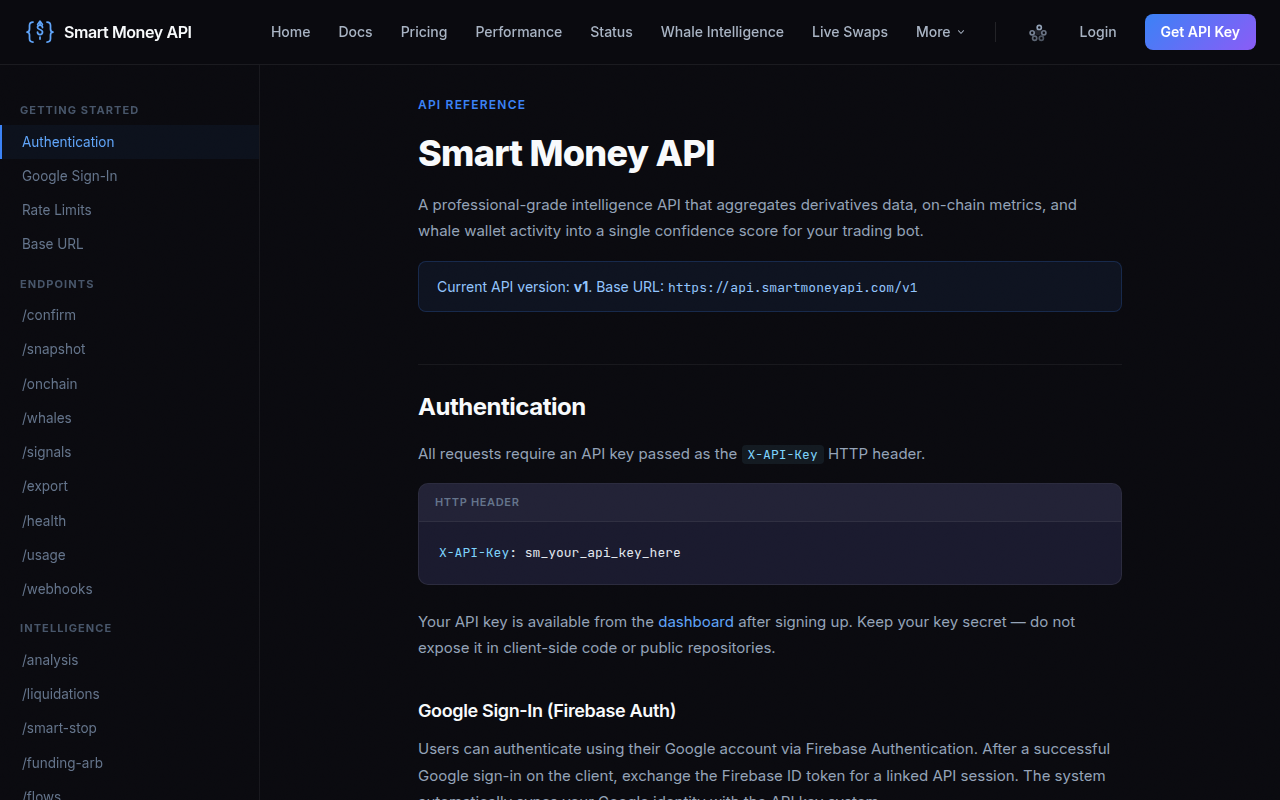
Smart Money API answers that question by fusing four institutional‑grade signals into a single composite score (0–1). It pulls derivatives data (funding rates, open interest, liquidations), on‑chain metrics (exchange reserves, active addresses, stablecoin flows), whale activity from 1,500+ tracked wallets, and macro/news sentiment. The result is a real‑time confirmation with a historical 62% win rate on trades tagged as HIGH confidence. This isn’t a lagging indicator; it updates every few seconds and can be polled with a simple GET request.
Here’s a live example of a BTC/USDT long confirmation:
GET /v1/confirm?symbol=BTC&direction=long
{
  "composite": 0.74,
  "confidence": "HIGH",
  "action": "CONFIRM",
  "size_mult": 1.5,
  "deriv_score": 0.81,
  "onchain_score": 0.68,
  "whale_score": 0.73
}
The response shows a composite of 0.74 (= HIGH), a size multiplier of 1.5× (suggesting you can scale into the position), and breakdowns for each data source. Developers use this as a gate: a bot places a buy order only if confidence == "HIGH". Combined with your chosen exchange API, it transforms a simple algo into a filtered, high‑probability engine. Dive deeper at Smart Money API documentation to see all endpoints, including confirmation for shorts, risk‑on/off metrics, and batch requests.
Using a confirmation API is not about replacing market data—it’s about adding a layer of logic that keeps you on the right side of institutional flows. And because the free tier is generous, it costs nothing to test against your existing strategies.
Building Your Bot Stack
Now that you understand the building blocks, assembling a production bot becomes a matter of wiring them together:
- Execution Layer: Choose an exchange API based on your asset class. Binance for spot/futures depth, Bybit for perpetuals, Coinbase for US compliance, Kraken for OTC fills.
- Data Feed: Use CoinGecko or CryptoCompare for multi‑exchange reference prices, or rely on the exchange’s WebSocket for order‑book‑only strategies.
- Confirmation Gate: Poll Smart Money API before entry. A simple check—
if confirmation['action'] == 'CONFIRM' and confirmation['confidence'] == 'HIGH'—can filter out 70% of whipsaws. - Risk Management: Calculate position size with precision. Our Advanced Position Calculator factors in leverage, stop‑loss distance, and portfolio equity to keep risk per trade exactly where you want it.
This stack runs on free tiers during development, then scales with modest costs as you increase throughput. The key is that each component is decoupled—you can swap exchanges or data providers without rewriting your logic; the confirmation API remains the constant, evidence‑based filter.
Start Building with Confidence – Free Smart Money API Key
Ready to elevate your bot from reactive order‑taker to an intelligence‑driven trader? Sign up for a free API key and instantaneously start receiving composite trade confirmations that the pros use. Pair it with your favourite exchange API, set a confirmation threshold, and watch your win rate improve. The only thing you have to lose is noise.