How Funding Rate Arbitrage Works
Perpetual futures are a cornerstone of crypto derivatives trading, offering traders the ability to maintain positions indefinitely without expiry. To anchor these contracts to the underlying spot price, exchanges apply a periodic funding rate—a fee exchanged between long and short positions. When the perpetual contract trades above spot, longs pay shorts a funding fee (positive rate); when below, shorts pay longs (negative rate). This mechanism creates a dynamic market where a savvy trader can collect the funding payments while eliminating directional risk—this is the essence of funding rate arbitrage.
In simple terms, funding rate arbitrage involves simultaneously holding a spot position and an equal-sized opposite perpetual futures position. By doing so, your portfolio remains delta-neutral: any price movement in the asset is offset by gains in one side and losses in the other. The profit comes from the funding rate you either receive or pay, depending on the side of your perpetual trade. Because the vast majority of crypto markets exhibit a persistent positive funding rate (perpetual > spot), the classic carry trade is to buy the asset on the spot market and short the perpetual contract. You earn the funding rate paid by perpetual longs to perpetual shorts.
A well-executed funding rate arbitrage turns the market’s leveraged long demand into a steady yield stream. With annualised yields frequently ranging from 5% to 30% or more during bullish periods, it has become a popular neutral yield strategy for both institutional and retail traders. The key is understanding the mechanics, selecting the right exchanges, and managing the subtle risks that can erode profitability. Historically, this strategy traces its roots to traditional basis trading in equities and commodities, but the unique funding mechanism of crypto perpetuals makes it far more accessible to individuals.
Understanding Perpetual Futures and Funding Rates
Unlike traditional futures, perpetual contracts do not have a settlement date. Instead, they rely on a funding mechanism to keep the contract price aligned with the spot index. Every funding interval (typically every 8 hours), the funding rate is calculated based on the premium or discount between the perpetual’s mark price and the spot price. If the perpetual trades above spot, the funding rate is positive and longs pay shorts. If below, it is negative and shorts pay longs. The rate is expressed as a percentage of position size and is applied directly to traders’ collateral balances.
For an arbitrageur targeting positive funding rates, the logic is straightforward: go long spot and short the perpetual. When the funding payment occurs, you receive the fee from the exchange (paid by longs). Because your spot position doesn’t pay or receive funding, you net the entire payment. However, it is crucial to understand that funding rates are not fixed; they fluctuate with market sentiment, leverage demand, and volatility. For example, during Bitcoin’s 2024 rally, average funding rates spiked to 0.1% per 8 hours on some exchanges, translating into an annualized return above 100% before fees—a dream scenario for carry traders.
What is a Funding Rate Arbitrage?
Funding rate arbitrage—often called basis trading crypto or a carry trade arbitrage—refers to the specific strategy of exploiting the difference between the spot and perpetual markets to lock in the funding income. The process consists of two simultaneous legs:
- Long Spot: Purchase the underlying asset (e.g., Bitcoin) on a spot exchange or with a spot broker.
- Short Perpetual: Open a short position of identical notional size on a perpetual futures exchange.
The outcome: you have zero net exposure to the asset’s price. If Bitcoin rises 10%, your spot gains 10% while your perpetual short loses 10%. If it falls 10%, the spot loses 10% and the short gains 10%. The only net profit or loss comes from the funding payments, trading fees, and any basis drift (the difference between the entry spread and the spread at exit). This is why it is considered a low-risk, market-neutral strategy—the directional element is hedged out.
While the concept is simple, executing it profitably requires careful attention to execution costs, margin requirements, funding rate sustainability, and platform risk. Even small miscalculations can turn a pristine yield setup into a subpar performer. That is why professional traders rely on precise calculators and robust data pipelines.
Spot vs Perpetual Price Basis
The price spread between spot and perpetual futures—commonly called the basis—is the fundamental driver behind funding rate arbitrage. A wide basis signals a strong premium in the perpetual, which typically results in higher funding rates. Conversely, a narrow or negative basis may foretell lower or even negative funding. Understanding how the basis evolves is key to timing entries and anticipating changes in your funding income.
The Basis Explained
The basis can be defined as the percentage difference between the perpetual contract price and the spot price: (Perpetual – Spot) / Spot. For example, if Bitcoin spot is $60,000 and the perpetual is $60,120, the basis is 0.20%. This premium indicates bullish sentiment and leveraged long demand. Exchanges compute the funding rate based partly on this premium, aiming to push the perpetual back toward spot. A basis of 0.20% might translate into a funding rate of about 0.01%–0.03% per 8 hours, depending on the formula and the specific exchange.
The basis is not static. It can expand during rapid rallies as traders rush to open leveraged longs, or contract during consolidation. Arbitrage traders actively monitor the basis to gauge when funding rates are likely to be sustained or prone to a reversal. A sudden collapse in the basis can erode future funding income and even lead to negative returns if you entered at a high spread and the basis mean-reverts sharply. Smart monitoring tools can alert you when the basis narrows beyond a threshold.
Why the Spread Occurs
Several factors contribute to a persistent basis in crypto markets:
- Leverage Demand: Bullish traders prefer perpetuals for leveraged long exposure. They bid up the contract above spot, creating the premium.
- Market Sentiment: Extreme greed drives speculation; the spread widens as more capital chases upside.
- Capital Efficiency: Perpetuals allow higher leverage with lower upfront capital than spot margin trading, attracting more leveraged buyers.
- Supply Constraints: Spot markets may have institutional selling pressure or limited liquidity, while perpetuals can absorb large speculative flows.
- Institutional Hedging: Large market participants selling futures to hedge spot long positions can temporarily invert the spread, but typically retail demand keeps it positive.
These structural factors ensure that a positive basis is common in crypto, providing a fertile environment for carry trades. However, bear markets or high volatility can occasionally flip the basis negative, opening the door to the inverse arbitrage (long perpetual, short spot), though shorting spot in crypto is complex and usually requires borrowing or inverse instruments.
Step-by-Step Setup
Now that the mechanics are clear, let’s walk through a real-world implementation of a funding rate arbitrage trade. Assume we target Bitcoin (BTC) because it has deep liquidity and tight spreads on both spot and derivatives markets. The goal: earn a steady yield without taking directional risk.
Step 1: Identify Funding Rate Opportunities
Start by scanning exchanges for positive funding rates that exceed your cost of capital and execution overhead. Use a funding rate calculator to estimate the annualised percentage yield based on current rates and funding intervals. A rate of 0.01% every 8 hours compounds to roughly 10.95% APR (assuming constant). But you must also account for the spread you’ll cross. Good opportunities typically show an APR above 8% after fees.
Beyond manual checking, leverage aggregation tools and API data to spot anomalies. Certain platforms like Binance, Bybit, OKX, and Bitget offer different funding rates for the same asset because of varying user bases and order book dynamics. A spread of funding rates across exchanges presents an even richer arbitrage, but introduces cross-exchange basis risk. Many traders stick to a single exchange to keep things simple. Look for pairs where the perpetual funding rate is consistently above 0.01% per 8 hours, and where there is sufficient volume to handle your intended size without slippage.
Step 2: Open Opposite Positions
Once you’ve identified an attractive funding rate, execute the two legs simultaneously to avoid slippage:
- Buy BTC spot. If starting with cash, purchase the exact amount you want to hedge. For example, buy 1 BTC at $60,000.
- Open a short perpetual position with a notional size of 1 BTC. Ensure you use the same quantity—not the same dollar amount if the perp price differs slightly—so the hedge is perfect. If the perp is at $60,120, you still short a 1 BTC contract. The basis difference (0.20%) is already accounted for in future funding payments.
- Place limit orders for both sides to minimize taker fees and reduce the impact of the bid-ask spread. A careful entry can save you 0.05–0.10% instantly.
Use an advanced position calculator to determine the exact position size, margin, and leverage required to remain solvent under various scenarios. Enter your account balance, desired leverage (keep it low, e.g., 1x–2x to avoid liquidation), and asset price to see your liquidation threshold. A properly funded hedge will have a liquidation price far from the current market. For instance, with 2x leverage and a $10,000 initial margin, your liquidation price on a BTC short could be as high as $140,000—well above any realistic move—giving you plenty of buffer.
Step 3: Manage and Monitor
After entry, the position becomes a passive income stream, but it’s not entirely hands-off. Monitor the funding rate regularly; if it drops near zero or turns negative, consider unwinding. Rebalancing might be needed if the basis changes significantly or if your wallet size grows (or shrinks) due to funding payments. A funding rate that averages 0.01% per 8 hours but suddenly slumps to 0.002% for several days can cut your annualized yield from 10.95% to 2.19%—a red flag.
Watch for funding payment schedules so you don’t miss collections. Automate alerts using trading bots or API monitors. Also, keep an eye on your margin ratio—especially if the crypto price experiences extreme volatility. With a short perpetual, a sharp rally could bring your position close to liquidation, even though your spot position offsets the PnL; the perpetual side uses isolated margin by default on many platforms. Switch to cross margin or add cushion to avoid forced closure. Rebalancing might involve adding more collateral to the futures account or adjusting the spot hedge size.
Exchange Comparison for Funding Rates
Not all exchanges are created equal when it comes to funding rate arbitrage. Differences in liquidity, fee structures, and funding calculation formulas can drastically affect profitability. The table below compares key metrics across popular platforms for a Bitcoin perpetual contract (data indicative as of Q2 2025).
| Exchange | Funding Interval | Typical Funding Rate (8h) | Max Leverage | Maker/Taker Fee (%) | Withdrawal Fee (BTC) |
|---|---|---|---|---|---|
| Binance | 8 hours | 0.01% – 0.03% | 125x | 0.02/0.04 | 0.0002 |
| Bybit | 8 hours | 0.01% – 0.03% | 100x | 0.02/0.055 | 0.0005 |
| OKX | 8 hours | 0.01% – 0.02% | 100x | 0.02/0.05 | 0.0003 |
| Bitget | 8 hours | 0.01% – 0.04% | 125x | 0.02/0.06 | 0.0005 |
| Deribit | 8 hours | 0.01% – 0.02% | 50x | 0.02/0.05 | 0.0004 |
Bitget and Binance often show slightly higher funding rates during bull runs due to strong retail leveraged demand. However, lower taker fees on Binance (when using BNB discount) can tip the scale in its favour after accounting for the cost of opening and closing the spot and perpetual legs. Always calculate the net effective funding rate after fees using a dedicated spreadsheet or the interactive tools at CryptoCalcs. Also note that funding rates can vary intra-day, and some exchanges adjust the payment frequency (e.g., every 4 hours), which can compound gains faster if you’re consistently receiving payments.
Protective Options Hedge
While funding rate arbitrage is directionally neutral in a perfect world, basis risk can introduce losses. If the perpetual premium collapses faster than your cumulative funding income, you might exit the trade with a net loss even though you collected funding along the way. To mitigate this tail risk, some traders overlay a protective options hedge.
The simplest hedge is purchasing a put option on the spot leg. For example, if you hold Bitcoin spot and short the perpetual, a sharp downside move doesn’t affect your delta-neutral position—but a rapid increase in the basis (funding rate drop) combined with a spot price decline could hurt your exit if you need to unwind. More commonly, a put can protect against liquidation risk on the short side: if Bitcoin explodes upward, your short perpetual risks liquidation even though your spot gains. A deep out-of-the-money call option on the perpetual (or call spread) can cap that risk. This isn’t a standard retail move, but for large portfolios, options hedging transforms a pure carry trade into a more robust yield strategy.
Cost-benefit analysis: Options premiums reduce your net yield. Use them sparingly and only when funding rates are extremely high or you detect macro volatility. For instance, buying a 1‑month 15% OTM call on BTC might cost 0.8% of notional, reducing APR by roughly 0.8% if held for a month, but it can prevent a forced liquidation during a 30% rally. For most retail arbitrageurs, proper position sizing and conservative leverage are sufficient to manage risk without options.
Fee Structure & Profitability
Profitability in funding rate arbitrage hinges on understanding and minimising the frictional costs that chip away at your yield. Let’s break them down systematically:
- Spot Trading Fee: Exchanges typically charge maker/taker fees on the spot purchase. If you place a limit order with 0% promo, you might pay 0.1% taker fee. This one-time cost applies to the initial buy and eventual sell.
- Perpetual Trading Fee: Opening the short incurs a taker fee (0.04% on Binance). Closing the position later adds another. Using limit orders can reduce this to maker fee rates.
- Funding Payments Owed: You receive funding, not pay it—so there’s no direct cost here. However, the funding rate itself isn’t guaranteed; a drop reduces income.
- Spread and Slippage: The spot–perp basis at entry and exit creates an implicit cost. If you enter at a basis of 0.20% and later unwind when the basis is 0.05%, you’ve “lost” 0.15% on the round trip, which must be netted from collected funding. Conversely, if the basis widens, you could profit on exit as well.
- Withdrawal and Network Fees: Moving BTC to a wallet incurs withdrawal fees (see table above). If you keep assets on exchange, you avoid these but assume custody risk.
- Opportunity Cost: Capital tied up in the hedged position could have been deployed elsewhere. Compare carry‑trade APR with staking yields or other low‑risk venues.
A realistic scenario: suppose you hold a 1 BTC arbitrage position for 30 days with an average funding rate of 0.01% per 8 hours. Gross yield = 30 days × 3 payments/day × 0.01% = 0.90% per month, or ~10.95% APR. Total round-trip fees (spot buy/sell, perp open/close) might be 0.30% of notional. If the basis unchanged, net yield = 0.60% per month, ~7.2% APR. If basis narrows by 0.10%, subtract that, net 0.50%. Still a respectable low-risk return. Use the funding rate calculator to model these costs quickly and adjust for your specific exchange’s fee schedule.
Liquidation Risk Management
The most common pitfall for new arbitrage traders is underestimating liquidation risk on the perpetual side. Holding a short position while spot rises doesn’t lose you money overall, because the spot gains offset the perp loss. But the perpetual exchange doesn’t know you own the spot; it only sees the short position and will liquidate it if the margin falls below maintenance levels. This can happen even if your total portfolio PnL is positive.
To manage this risk effectively:
- Use Cross Margin: Allocate a larger portion of your account as collateral for the perpetual. Cross margin pools all assets from your futures wallet, reducing the chance of individual position liquidation.
- Hold Adequate Buffer: Maintain a margin ratio well above the liquidation threshold—at least 200% for extreme volatility. The advanced position calculator can help you size this.
- Avoid High Leverage: While you can open a short with 125x leverage, doing so drastically lowers your liquidation price. Stick to 1x–3x on the short leg. At 2x leverage with a liquidation price far above the current market, a 50% rally still poses no threat.
- Rebalance Actively: If BTC accelerates upward, your short’s margin ratio deteriorates. You can add collateral or partially reduce the spot position to free up capital for the futures wallet. Some bots automate this via API.
- Monitor Funding Rate Signals: An uptick in the funding rate often coincides with a crowded long market that could reverse sharply. Using composite market intelligence like the Smart Money API helps you stay aware of whale accumulation that might precede a short squeeze, allowing you to tighten stops or take preventive measures. The API’s whale score checks for large wallet movements that historically foreshadow squeezes.
Remember, a liquidation event destroys the hedge and leaves you with unhedged exposure, potentially turning a low-risk strategy into a high-risk one overnight. Never over-leverage the perpetual leg; the funding payments are meant to be collected, not gambled.
Automated Arbitrage Tools & APIs
Scaling funding rate arbitrage requires automation. Manually checking rates, opening two positions, and monitoring margin across exchanges is inefficient and error-prone. Programmatic tools and APIs can streamline the entire workflow.
For traders who want to confirm whether a funding rate opportunity is worth pursuing, the Smart Money API provides a composite trade confirmation endpoint. By fusing derivatives data, on-chain activity, whale wallet movements, and macro news sentiment, it delivers a single score that helps you judge the probability of a profitable carry trade. For example, a HIGH confidence signal would indicate that the current funding rate is supported by strong fundamentals and unlikely to collapse shortly.
Here’s what a sample API response looks like when querying the trade confirmation endpoint for Bitcoin with a long spot / short perpetual setup:
GET /v1/confirm?symbol=BTC&direction=long
{
  "composite": 0.74,
  "confidence": "HIGH",
  "action": "CONFIRM",
  "size_mult": 1.5,
  "deriv_score": 0.81,
  "onchain_score": 0.68,
  "whale_score": 0.73
}
The composite score (0.74) and confidence level (HIGH) suggest that the funding rate arbitrage setup is solid. The API also recommends a position size multiplier (1.5), meaning you could safely increase your allocation relative to baseline. This is invaluable for traders who want data-driven conviction before deploying capital.
To implement automation, you can write a simple script in Python that:
- Pulls funding rates from your preferred exchange via its API.
- Queries the Smart Money API
/v1/confirmendpoint for confirmation. - Calculates optimal position size using CryptoCalcs advanced position calculator parameters.
- Executes simultaneous spot and perpetual orders when criteria are met.
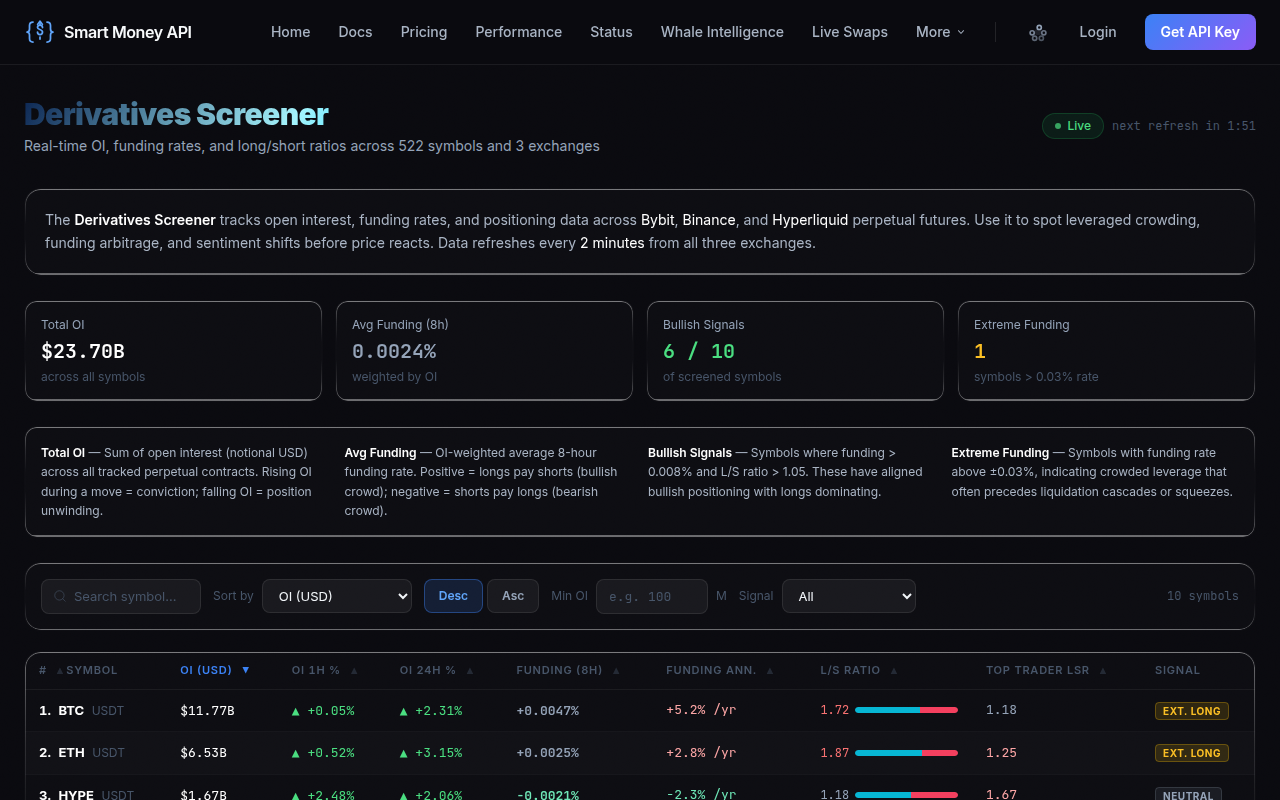
Many traders combine the derivative screener on Smart Money API with exchange APIs to scan multiple assets and discover the best funding rate anomalies automatically. The free tier of the Smart Money API provides limited but sufficient credits to test the concept before scaling. With a solid script, you can run a funding rate farm across 5–10 altcoins simultaneously, capturing multiple funding streams while staying delta‑neutral on each.
Conclusion: Turn Funding Rates into Consistent Yield
Funding rate arbitrage remains one of the most reliable market-neutral strategies in crypto. By harnessing the persistent premium on perpetual futures, traders can earn consistent yield that is uncorrelated with market direction. The strategy’s low-risk nature makes it attractive for both passive income seekers and sophisticated hedge funds looking for delta-neutral returns. As crypto markets mature, institutional players are increasingly deploying carry trade strategies, but ample opportunities remain for individuals who act with precision.
Success however, depends on meticulous attention to detail: choosing the right exchange, keeping fees low, managing liquidation risk, and staying alert to shifts in the basis. Tools like the CryptoCalcs calculators streamline the math, while data platforms such as the Smart Money API add an extra layer of confidence by filtering fakeouts and confirming genuine opportunities with on-chain and whale intelligence.
Ready to build your own funding rate arbitrage system? Start with a free API key from Smart Money API and pair it with the funding rate calculator on CryptoCalcs. With a disciplined approach, you can turn the crypto market’s leveraged demand into a steady, low-risk income stream.