News Sentiment Sources
Major Crypto News Aggregators and Social Platforms
News sentiment in crypto doesn’t come from a single pipe. Traders monitor a web of publishers—CoinDesk, The Block, Decrypt—supplemented by real-time social chatter on X (Twitter), Reddit’s r/CryptoCurrency, and Telegram trading groups. Each source has a different half‑life: a CoinDesk exclusive can move price in seconds; a viral tweet from a pseudonymous analyst may take minutes to propagate. Aggregation platforms like CryptoPanic and LunarCrush become essential to track the firehose. But the raw news feed alone isn’t tradeable. What matters is the sentiment vector embedded in the language. A headline reading “Bitcoin ETF decision delayed” carries a different sentiment than “SEC postpones ETF ruling, citing need for more data.” The subtlety is where alpha hides, and traders need pipelines that convert language into actionable numbers.
On‑Chain and Whale Alert Data as Sentiment Proxies
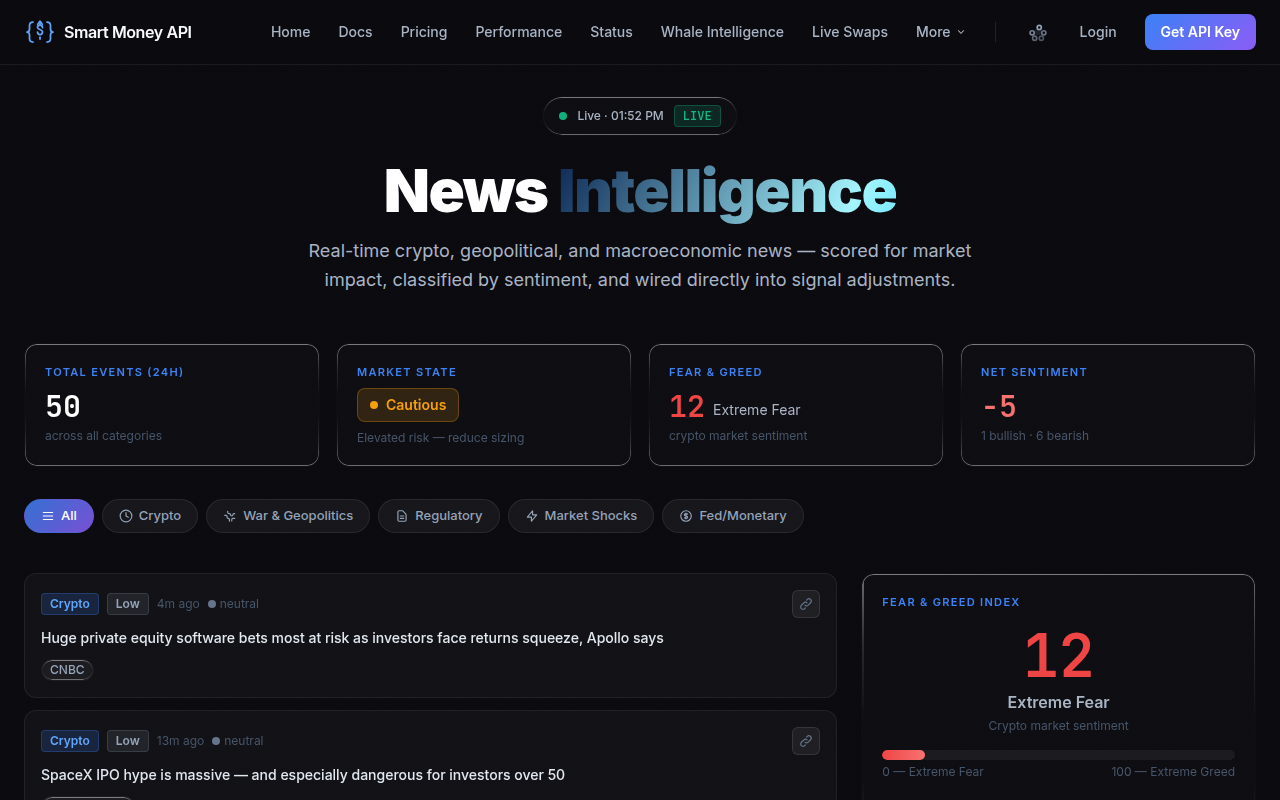
Not all sentiment is expressed in words. Large on‑chain movements—a dormant wallet waking up, a spike in exchange inflows, or a sudden accumulation by addresses holding 1,000+ BTC—carry their own narrative. Whale alerts, available through services like Whale Alert and Glassnode, can act as sentiment catalysts: a 10,000 BTC transfer to Coinbase is often interpreted by the market as a bearish signal (potential sell pressure), even if the intent is just custody management. These events get digested by sentiment analysis algorithms just like news headlines. The volume and velocity of such transfers, combined with the emotional reaction they generate on social media, create a feedback loop that amplifies price swings. An advanced trading‑intelligence API like Smart Money API’s news dashboard ingests these signals alongside traditional news, assigning a composite weight that filters noise from genuine sentiment shifts.
Real‑Time Dashboards and API Pipelines
Manual news scanning is a losing game against algos. Professional traders build pipelines that listen for keywords, parse sentiment, and spit out scores in milliseconds. Dashboards like the one from Smart Money API overlay sentiment scores directly on price charts, showing when news sentiment flips from neutral to strongly positive or negative. Whether you’re trading BTC on a 15‑minute chart or managing a cross‑alt portfolio, integrating a sentiment‑aware API removes lag. The fusion of curated news feeds, social volume metrics, and on‑chain alerts into one interface turns raw data into a unified sentiment stream.
Quantifying Sentiment: Positive/Negative/Neutral
Natural Language Processing Scoring of Headlines
At the heart of news‑based trading lies Natural Language Processing (NLP). Lexicon‑based models like VADER assign a compound score from -1 (extremely negative) to +1 (extremely positive) by scanning for adjectives, capitals, and emotive punctuation. More sophisticated transformer models (FinBERT, tuned on financial text) capture context—differentiating “Bitcoin crashes through $50k” (bullish breakout) from “Bitcoin crashes to $30k” (bearish collapse). These NLP pipelines process headlines in near‑real time, and traders use the scores to gauge the ambient mood. A stream of headlines averaging -0.65 for an hour statistically precedes sell‑offs; a sustained +0.70 precedes rallies. The key is not a single headline, but the direction and magnitude of the rolling sentiment average.
Social Volume and Engagement Metrics
Sentiment isn’t just about the score—it’s also about virality. Social volume (number of mentions, retweets, shares) acts as a multiplier. A mildly bullish article shared by 100 accounts matters less than a moderately bullish tweet that racks up 50,000 impressions and sparks a Reddit thread. Traders track metrics such as bullish‑vs‑bearish comment ratio, unique social contributors, and “social dominance” (percentage of total crypto chatter devoted to a specific asset). Spike in social volume often precedes a price move by 30–90 minutes. When volume and sentiment align—say, high positive sentiment plus 3‑sigma social volume—the probability of a directional move increases materially.
Volume‑Weighted Sentiment Indices
To avoid being whipsawed by a single viral post, sophisticated systems weight sentiment by source credibility and market impact. A tweet from an exchange CEO receives 10x the weight of an anonymous account. Paid press releases get lower trust coefficients than independent journalist articles. The result is a volume‑weighted sentiment index that resembles a moving average. For example, Bitcoin’s daily weighted sentiment might dip to -0.4 as several negative media pieces, a whale transfer, and a regulatory rumor converge—giving a robust signal to de‑risk. Cross‑referencing such weighted indices with price action can reveal divergences (negative sentiment but price holding support) that are powerful mean‑reversion cues.
Composite Scores and Trade Confirmation Signals
The ultimate step is fusing sentiment with other market pillars: derivatives flow, on‑chain data, and whale activity. This creates a composite trade‑confirmation score that reduces false signals. Instead of acting on fear‑inducing headlines alone, a trader asks: “Do the options flows agree? Is on‑chain accumulation happening?” Only when multiple pillars concur does the signal carry conviction. For example, the Smart Money API’s confirmation endpoint combines derivatives, on‑chain, whale movements, and news sentiment into a single composite score. A request like this:
GET /v1/confirm?symbol=BTC&direction=long
{
  "composite": 0.74,
  "confidence": "HIGH",
  "action": "CONFIRM",
  "size_mult": 1.5,
  "deriv_score": 0.81,
  "onchain_score": 0.68,
  "whale_score": 0.73
}
The response shows a composite of 0.74 on a scale where 0.70+ historically delivered a 62% win rate on HIGH signals. This means the news sentiment component (baked into the composite) isn’t isolated—it’s cross‑verified, helping traders avoid knee‑jerk reactions to a single sensational headline.
Fear & Greed as News Proxy
Crypto Fear & Greed Index Mechanics
The Crypto Fear & Greed Index (Alternative.me) distills multiple data points into a single 0‑100 number. It weighs volatility (25%), market momentum/volume (25%), social media sentiment (15%), surveys (15%, paused currently), Bitcoin dominance (10%), and trends (10%). Because inputs like social sentiment and volatility spike in response to breaking news, the index acts as a real‑time news proxy. A clutch of negative regulatory headlines can yank the index from 50 (neutral) to 15 (extreme fear) in a single session. This collapse signals not just price selling, but an emotional capitulation that often precedes a local bottom.
Historical Correlation of Extreme Fear with Bottoms, Greed with Tops
Historical data strongly supports using the index as a contra‑indicator at extremes. Below is a comparison of notable BTC price points and corresponding Fear & Greed readings, with the 7‑day forward return:
| Date | BTC Price (USD) | Fear & Greed | Sentiment Label | 7‑Day % Change |
|---|---|---|---|---|
| 13 Mar 2020 | 4,000 | 8 | Extreme Fear | +52% |
| 18 Jun 2022 | 17,600 | 6 | Extreme Fear | +14% |
| 10 Nov 2021 | 69,000 | 82 | Extreme Greed | -11% |
| 14 Mar 2023 | 20,000 | 33 | Fear | +3% |
| 24 Jul 2023 | 30,000 | 55 | Neutral | -1% |
The table illustrates that extreme fear (<25) frequently preceded significant bounces, while extreme greed (>75) often marked short‑term tops. That makes the index a valuable sentiment filter: rather than buying on any dip, a trader might wait for Fear to spike below 20 before sizing into a long, using news as the trigger and the index as confirmation.
Contrarian Strategies Using Fear & Greed
Buying when sentiment is terrified and selling when euphoric is the classic contrarian playbook. Implementing it requires a rules‑based system: for instance, dollar‑cost average into BTC only when the Fear & Greed index is below 25, and take profits when it crosses above 75. When combined with a composite signal like the Smart Money API’s HIGH confidence confirmation, the strategy becomes even more robust. The API’s composite score effectively filters whether the extreme fear is justified by fundamentals or merely an overreaction. This marriage of sentiment index and data‑fusion reduces drawdowns that can occur when trying to catch a falling knife.
Regulatory News Timeline Impact
How SEC/CFTC Announcements Shift Sentiment in Minutes
Regulatory headlines are the most violent catalysts in crypto. A single tweet hinting at ETF approval or a lawsuit filing can move BTC 5‑10% in an hour. Sentiment analysis engines parse the language for clues: “the SEC is considering…” creates uncertainty (neutral/negative), whereas “Bitcoin spot ETF approved” instantly sends sentiment to extremely positive. The speed is critical—by the time a retail trader reads a news aggregator, algorithmic systems have already executed. That’s why tracking the rate of change in sentiment scores is more actionable than absolute level. A sentiment score leaping from -0.2 to +0.9 in under 60 seconds flags a regime‑change event, demanding a trader’s immediate attention.
Global Regulatory Divergence and Cross‑Border Sentiment
Not all jurisdiction news hits equally. China’s mining ban in 2021 tanked the market, yet subsequent bans from other nations barely registered. Europe’s MiCA regulation is viewed positively (clarity), while potential US enforcement actions often spark fear. Sentiment models that isolate by region can identify arbitrage opportunities: if European sentiment turns bullish on MiCA while US sentiment remains cautious, Bitcoin might rally on EUR pairs first. Tools that geolabel social posts and headlines allow a granular view of how regulatory sentiment flows across borders. This regional sentiment data is part of the news dashboard offered by Smart Money API, helping traders see which region’s headlines are driving the tape.
Measuring the Sell Pressure from Negative Regulatory Headlines
Quantifying the price impact of a regulatory event is crucial for risk management. After a negative announcement, a quick analysis can measure average drawdown, recovery time, and volume anomaly. For instance, the SEC’s lawsuit against a major exchange caused an average 12% drop in BTC over 6 hours, with full recovery taking 3 days. Traders can feed these historical patterns into their playbook. After an event, you can use a crypto ROI calculator to backtest the profitability of a quick long or short position based on the expected bounce or continuation. This transforms emotional fear into a data‑driven expectancy.
Influencer & Headline Risk
Elon Tweets, CZ Announcements, and Price Spikes
Few forces move price like a high‑profile influencer tweet. Elon Musk’s Dogecoin memes, CZ’s “funds are SAFU,” or a CEO’s cryptic emoji can send an asset parabolic. Sentiment tracking systems now have dedicated “influencer watchlists” that instantly flag posts from accounts with a history of moving markets. NLP models classify these tweets not just by sentiment, but by “impact potential”—estimated from historical price reactions. When a tweet from an account tagged as “high‑impact” flips sentiment by more than 0.5 points, automated strategies kick in. This is headline risk in its purest form, where the narrative outweighs fundamentals for minutes to hours.
Trading Bots That Parse Influencer Sentiments
A cottage industry of bots now monitors X (Twitter) for key accounts and trades the sentiment. These bots go beyond simple keyword checks; they analyze linguistic constructs, sarcasm detection (especially tricky with crypto), and even image sentiment (memes). Some bots feed into API outputs, giving traders a real‑time influencer sentiment score for a given asset. The challenge is separating noise from signal—a single joke tweet can trigger a bot cascade, causing a flash pump‑and‑dump. That’s why combining influencer sentiment with volume filters and market structure is essential.
Mitigating Reactionary Trades with Confirmed Data
Jumping on a tweet spike without confirmation is gambling. A disciplined approach uses the influencer sentiment as an alert, then checks other pillars. Is on‑chain netflow confirming accumulation? Are derivatives showing open interest build‑up in the same direction? The Smart Money API’s composite score, mentioned earlier, acts as a final gatekeeper: only when the aggregate score is HIGH does the trade get a green light. This simple rule prevents being the last one into a 15‑minute fad while positioning for genuine trend continuations.
Sentiment + Technical Confluence
Aligning Sentiment Extremes with Support/Resistance Levels
The highest‑probability trades occur when news sentiment aligns with key technical levels. Imagine Bitcoin retests a major support zone while the Fear & Greed index drops to 10 and news headlines are overwhelmingly bearish—sentiment screams “sell,” but price holds the support. That bullish divergence is the kind of setup where composite scores spike. Similarly, a burst of euphoric headlines pushing an asset into a multi‑month resistance often precedes rejection. Plotting sentiment scores directly on a candlestick chart reveals these convergences, enabling traders to anticipate reversals before they happen.
Volume Profile and Sentiment Spikes
Volume adds a critical filter to sentiment signals. A positive sentiment surge without a corresponding spike in volume often fizzles. Conversely, when high social mentions (volume) coincide with a bullish sentiment breakout above a high‑volume node, the move tends to sustain. Smart money tracks the sentiment‑volume ratio: a sustained period where sentiment remains positive but volume dries up warns of exhaustion. This nuance is embedded in the composite score that Smart Money API generates, because derivatives and on‑chain volume are part of the calculation, not just raw headlines.
Backtesting Sentiment‑Technical Confluence Strategies
To trust any sentiment overlay, backtesting is mandatory. Historical data shows that buying when both a proprietary sentiment score crosses above 0.6 and price breaks above the 20‑day moving average delivers a higher win rate than either signal alone. Platforms that offer this kind of fused data can simulate years of trades in minutes. Smart Money API’s backtesting environment lets traders test sentiment‑technical rules, confirming that HIGH composite signals indeed beat the market. The 62% win rate on HIGH signals is a result of rigorous confluence, blending sentiment, whale activity, and on‑chain flows into a single actionable metric.
Avoiding News-Driven FOMO
Identifying Overreactions and Mean Reversion
News‑driven spikes almost always revert partially. A coin that rockets 30% on a rumor will often give back half those gains within 24 hours. FOMO (fear of missing out) is the biggest destroyer of trading capital. Analysing the speed and magnitude of a move relative to the sentiment score can flag overextended conditions. A simple rule: if the price moves more than two standard deviations beyond the sentiment‑implied move, a mean‑reversion pullback is likely. Combining this with the composite score prevents entering at the peak of hype.
Setting Entry Rules Based on Sentiment Consensus
To inoculate against FOMO, build mechanical buy rules. For example: only enter a long when weighted news sentiment is >0.4, social volume is rising, and the composite confirmation from a data‑fusion API is HIGH. Conversely, short only when sentiment < -0.4 and the composite indicates weakness. This removes emotional override. The consistent application of a rules‑based sentiment filter, rather than “I feel like this news is big,” separates professional traders from gamblers.
The Role of Composite Scores in Filtering FOMO
A lot of breaking news is already priced in by the time you see it. A composite score that integrates whale and derivative data can tell you whether “smart money” is buying the rumor or selling the news. For instance, a bullish article might be published, but if the composite score shows whale wallets net selling and derivatives funding turning negative, the signal might actually be CONFIRM SHORT. This dual‑check saves traders from chasing headlines into traps. It’s the reason the Smart Money API’s confirmation endpoint doesn’t rely on news alone—it demands corroboration, drastically reducing FOMO‑driven losses.
Building a News Calendar for Trading
High‑Impact Recurring Events
Some news events are entirely predictable: FOMC minutes, CPI releases, Bitcoin halving dates, and quarterly earnings reports from crypto‑adjacent companies (like Coinbase). A trader who prepares a calendar of these dates can anticipate sentiment swings. Ahead of CPI, sentiment often tilts cautious; after a dovish print, it flips bullish. Tracking historical sentiment reactions to each event type allows a “schedule‑based” sentiment play: go neutral before uncertainty, then trade the resolution.
Economic Calendars vs. Crypto‑Specific Metrics
Traditional forex economic calendars matter for crypto because Bitcoin increasingly acts as a macro asset. Yet, crypto‑specific events—network upgrades, token unlocks, governance votes—often generate more concentrated sentiment shocks. A combined calendar that juxtaposes macro dates and project‑specific milestones gives a comprehensive view. Sentiment analysis tools can then weigh the expected impact, scoring each event in advance. When the actual event occurs, the real‑time sentiment shift relative to expectation creates trading opportunities.
Automating Alerts and Actionable Notifications
The ultimate news‑sentiment system works while you sleep. By connecting an API to a calendar and a messaging bot (Telegram, Discord), you can receive “sentiment breakout” alerts the moment a high‑impact event triggers a composite score shift. For example, “BTC sentiment flipped from -0.2 to +0.75 on ETF news; composite CONFIRM LONG, confidence HIGH.” This turns a manual, stressful news‑watching job into a streamlined, event‑driven strategy. Setting up such automation is exactly the use case for the Smart Money API’s real‑time endpoints, which combine news, on‑chain signals, and whale tracking into a single push notification.
Conclusion: Turn News Noise into Actionable Signals
News and social sentiment are the pulse of crypto markets, but raw headlines are a minefield of whipsaws and FOMO. Quantifying sentiment—through NLP scores, Fear & Greed proxies, and composite fusion with derivatives and on‑chain data—transforms chaos into a measurable input. The key is to never trade news in isolation; instead, let confirmed, high‑confidence signals guide your entries and exits. Tools like the Smart Money API create that confluence, delivering a single composite score that tells you whether the market’s words match its money. If you’re ready to stop reacting and start trading with disciplined confirmation, grab your free API key and integrate real‑time news‑sentiment analytics into your stack today.