The Problem with Single-Signal Trading
Most retail traders enter positions based on a solitary indicator. A moving average crossover, an RSI oversold reading, or a breaking-news headline triggers the buy button. While these signals occasionally work, they fail to account for the complex, multi-dimensional nature of crypto markets. The result is predictable: a win rate that hovers near 50%, drawdowns that erase weeks of gains, and a nagging sense that you’re trading blind.
Single-signal trading ignores the reality that markets are ecosystems of competing forces. A bullish technical pattern may form while on-chain data shows distribution by whales, derivatives traders are heavily short, and macro risk looms. Entering on that lone signal is a gamble, not a trade. The solution is a structured approach: trade confirmation signals that demand agreement across multiple independent layers of analysis before capital is committed.
This is the essence of multi-factor confirmation trading. Instead of one trigger, you build a composite score from derivatives, on-chain metrics, whale activity, and macro sentiment. When all layers align, the signal’s probability of success skyrockets. When they don’t, you stay flat—preserving capital for the next high-conviction setup.
What Makes a Confirmation Score?
A confirmation score aggregates separate data pillars into a single actionable metric. Think of it as a jury: each layer casts a vote, and only a unanimous or supermajority verdict triggers a trade. The score typically ranges from 0 to 1 (or 0% to 100%), with thresholds like LOW (<0.4), NEUTRAL (0.4-0.6), and HIGH (>0.6) defining entry quality. By demanding multiple confirmations, you drastically reduce false signals crypto environments are notorious for.
Here’s what a robust trading signal confirmation framework includes:
- Derivatives Layer: Funding rates, open interest, long/short ratios, liquidations.
- On-Chain Layer: MVRV, SOPR, exchange net flows, active addresses, volume.
- Whale Layer: Large wallet accumulation/distribution, smart money flows, exchange whale ratio.
- News/Macro Layer: Sentiment indices, regulatory headlines, macro risk events, fear & greed.
When these layers are fused into composite trade signals, the result is a risk-managed entry signal far more reliable than any standalone indicator. Traders who adopt this method often find themselves taking fewer trades but with dramatically higher conviction—and returns.
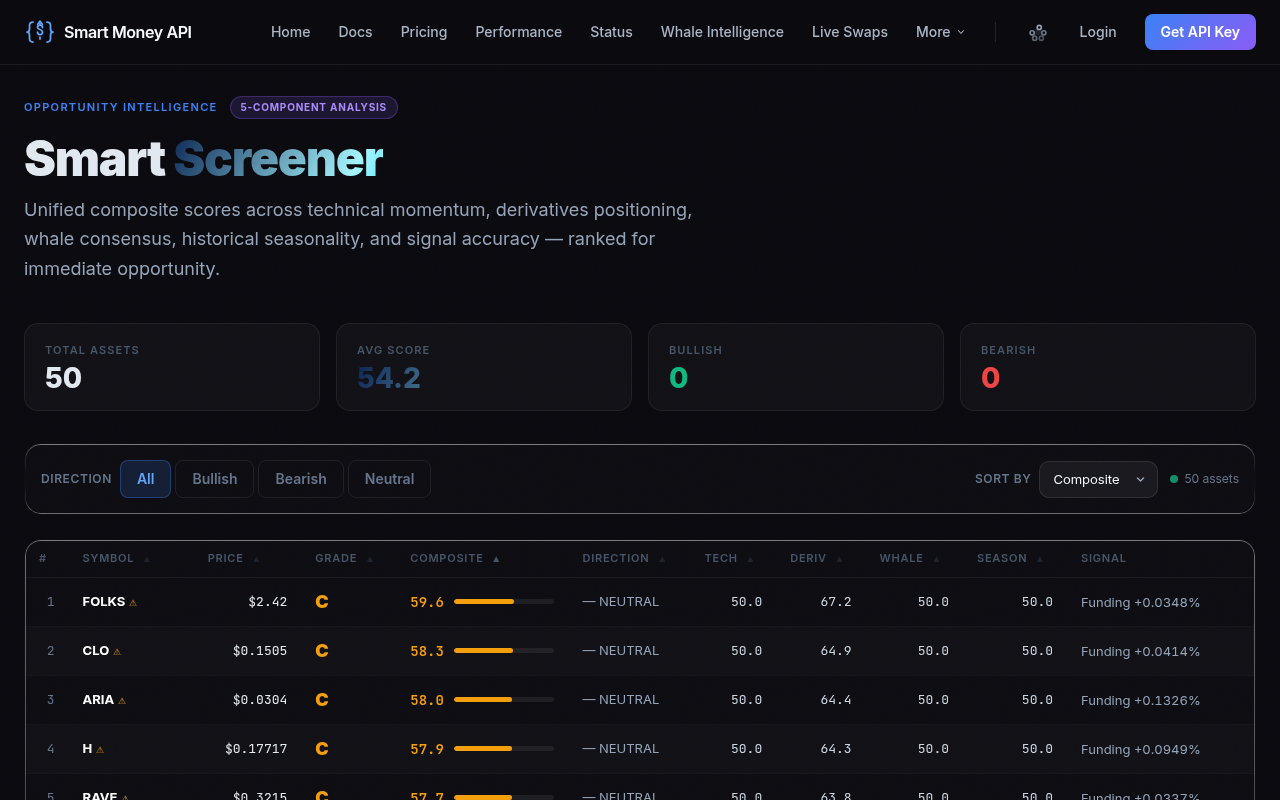
Advanced platforms like the Smart Money API have codified this approach into a live composite score. Their system ingests derivatives, on-chain, and over 1,500 tracked whale wallets, then outputs a single confirmation metric. In historical backtests, trades taken only on HIGH confidence signals (score >0.6) achieved a 62% win rate, with an average profit factor of 1.8. The free tier offers a taste of this multi-layer validation, removing the guesswork from signal confirmation.
Why Score Thresholds Matter
Without a threshold, a composite signal is just another number. By only acting when the score exceeds a predetermined level (say, >0.65), you inherently filter out low-probability noise. This is where trading signal confirmation becomes systematic. The threshold can be dynamic—raising it during bear markets, lowering it during strong trends—but the key is consistency. A score-based approach also lets you scale position sizing: a higher score justifies a larger allocation (using a tool like the position size calculator), while a borderline score suggests a half-size pilot position.
Derivatives Layer: Funding + Long/Short Imbalance
The derivatives market is a fickle beast. Perpetual swap funding rates reflect the balance of long and short demand. Extreme positive funding (overly bullish) often precedes corrections, while negative funding in an uptrend hints at a contrarian opportunity. However, using funding alone is noisy—it must be paired with open interest and the long/short ratio for true trade confirmation signals.
Funding Rate as a Contrarian Barometer
When funding rates are excessively high (>0.1% every 8 hours), the market is overleveraged to the upside. Institutional players and smart money often fade retail euphoria. Conversely, negative funding during accumulation phases is a strong addition to a multi-factor confirmation trading checklist. A composite score should penalize long entries when funding is in the danger zone and reward them when funding is neutral or slightly negative.
Long/Short Ratio and Open Interest
The aggregate long/short ratio tells you the crowd’s bias. A ratio above 3 (three longs for every short) is a crowded trade, ripe for a squeeze in either direction. Open interest changes provide the momentum: rising OI alongside rising prices confirms trend strength; rising OI with flat prices suggests distribution. For a robust score, you might require: funding < 0.05%, long/short ratio below 2, and OI growth aligned with price action. Missing any of those would lower the derivatives sub-score, feeding into the overall composite.
Liquidation Heatmaps
DeFi exchanges publish live liquidation levels. Concentrations of liquidation orders act as magnets. If a long signal coincides with a large cluster of short liquidations just above current price, the probability of a run on those stops increases—a positive confirmation. Adding this to your derivative layer sharpens composite trade signals.
On-Chain Layer: MVRV, SOPR & Volume
Blockchain data is the ultimate truth machine. It shows what participants are actually doing with their coins, not what they say or how they speculate. For trading signal confirmation, on-chain metrics like Market Value to Realized Value (MVRV) and Spent Output Profit Ratio (SOPR) are invaluable.
MVRV Z-Score: Over/Undervaluation
MVRV compares the current market cap to the realized cap (the price at which each coin last moved). An MVRV Z-score above 3 or 4 historically indicates overvaluation and topping zones; below 1 suggests undervaluation. A long entry signal aligned with an MVRV Z-score in the green zone (e.g., <2) receives a higher confirmation score. Pairing this with a short-term SOPR trend is even better.
SOPR and Exchange Net Flows
SOPR measures the profit/loss ratio of coins moved on-chain. Values >1 mean sellers are in profit; consistently >1 but declining may hint at profit-taking exhaustion. When SOPR drops below 1 and then rebounds, it signals a bottom. Meanwhile, exchange net flows—whether coins are moving onto exchanges (sell pressure) or off exchanges (accumulation)—offer a real-time supply/demand snapshot. A long trade confirmation signal should see coins leaving exchanges and SOPR showing a healthy reset.
On-Chain Volume and Active Addresses
Rising daily active addresses and transfer volume during a price dip suggests strong underlying network usage. This divergence (price down, fundamentals up) is a classic on-chain confirmation for value plays. When building a composite trade signal, an on-chain sub-score can be constructed from these five metrics—MVRV, SOPR, exchange net flows, active addresses, and whale exchange ratio—to output a single number that feeds the master score.
Whale Layer: Smart Money Accumulation
Whales—wallets holding 1,000+ BTC or equivalent—move markets. Tracking their behavior is a powerful layer of multi-factor confirmation trading. Not all whale moves are equal: exchange inflows from known whale wallets may signal impending sale, while outflows to cold storage suggest accumulation.
Smart Money Wallet Tracking
Platforms like Smart Money API track over 1,500 high-confidence smart money wallets, individuals and entities with a history of profitable market timing. A sharp increase in smart money buying, especially during market-wide fear, is the ultimate trade confirmation signal. The API’s whale score component quantifies this, ranging from 0 (heavy distribution) to 1 (heavy accumulation). When this score reads 0.73 alongside strong derivative and on-chain scores, as in the example below, the composite signal becomes actionable.
Whale Exchange Ratio
The ratio of whale exchange inflows to outflows directly measures intent. A reading below 0.5 (more coins leaving exchanges than entering) is generally bullish. When this pattern holds across multiple large-cap assets, it adds weight to any composite trade signal. Incorporating whale behavior helps reduce false signals crypto traders often face when following retail sentiment alone.
News/Macro Layer: Sentiment & Risk Events
Even the strongest technical and on-chain setup can be wrecked by a macro event—a Fed rate decision, regulatory crackdown, or major protocol hack. The news/macro layer acts as a gate: no matter how good the composite score is, if a high-impact event is imminent, the system scales down conviction or delays entry.
Crypto Fear & Greed Index
This simple gauge ranges from 0 (Extreme Fear) to 100 (Extreme Greed). Contrarian rules apply: long signals in Extreme Fear (below 25) are statistically more likely to succeed than those in Extreme Greed (above 75). Integrating the index into your confirmation score can be as straightforward as adding a multiplier: e.g., a long signal in Extreme Fear gets a 1.2x bonus, while one in Greed gets a 0.8x penalty.
Macro Calendar and Risk Management
CPI releases, FOMC minutes, and major regulatory announcements move all risk assets. A risk-managed entry signal checks the calendar before firing. Tools like the risk management calculator can help size positions around these events, reducing exposure when volatility spikes are likely. The news layer might also include social volume spikes, sentiment scores from natural language processing, and even GitHub activity for project-specific coins.
Building Your Confirmation Score
Now comes the synthesis. You’ll define weights for each layer (derivatives, on-chain, whale, macro) based on your strategy and backtest them. A typical approach is a weighted average of sub-scores. Below is a real-world API response from Smart Money API that exemplifies this fusion. The endpoint /v1/confirm takes a symbol and direction, returning a composite score and actionable guidance.
GET /v1/confirm?symbol=BTC&direction=long
{
  "composite": 0.74,
  "confidence": "HIGH",
  "action": "CONFIRM",
  "size_mult": 1.5,
  "deriv_score": 0.81,
  "onchain_score": 0.68,
  "whale_score": 0.73
}
In this snapshot, BTC long is confirmed with HIGH confidence. The composite 0.74 exceeds the 0.6 threshold, and each sub-score is above 0.6, indicating broad agreement. The size_mult of 1.5 suggests you can safely increase normal position size by 50%—a risk-managed entry signal that directly impacts profit potential. Without such multi-factor validation, a lone technical indicator might have still said YES, but the odds would have been far lower.
Weighting and Customization
Not all layers are equally predictive in all market regimes. During bull runs, derivatives and whale data might carry more weight; during bear markets, on-chain fundamentals and macro dominate. An effective trading signal confirmation framework is not static. You might assign base weights: derivatives 30%, on-chain 30%, whale 25%, macro 15%. Then, based on regime (trending, ranging, high volatility), adjust dynamically. Backtesting is crucial to find the right mix.
Automating the Score
Manually computing these sub-scores across multiple assets is impractical. That’s why tools like the Smart Money API exist. They consolidate the data pipeline and deliver a ready-to-use composite number, freeing the trader to focus on execution. Their free tier provides hourly updates on up to 5 assets, a perfect starting point for those new to composite trade signals.
Backtesting Multi-Factor Setups
No framework is complete without rigorous backtesting. Fortunately, with modern crypto data APIs, you can replay historical signals to see how multi-factor confirmation would have performed. The goal is to measure win rate, profit factor, max drawdown, and average R-multiple versus a single-signal baseline.
Simulating Historical Scores
If you have access to historical derivatives, on-chain, and whale data, you can reconstruct past composite scores. Run through several market cycles (2021 bull, 2022 bear, 2023 recovery) and log every time the composite crossed your threshold. Track outcomes after a standard holding period (e.g., 24 or 48 hours for swing trades). The table below illustrates a hypothetical backtest of a multi-factor system vs. a simple RSI-based approach on BTC/USD over 18 months:
| Signal Source | Trades | Win Rate | Total P&L (R multiples) | Max Drawdown |
|---|---|---|---|---|
| RSI <30 only | 87 | 43% | +2.1R | -8.4R |
| Composite Score >0.6 | 41 | 61% | +18.7R | -3.1R |
| Composite Score >0.75 | 22 | 72% | +15.9R | -1.8R |
The multi-factor approach dramatically cut trade frequency while boosting win rate and total P&L. Most importantly, the max drawdown was a fraction of the single-signal system—exactly what risk-managed entry signals are designed to achieve. By filtering out low-quality setups, you preserve mental and financial capital for the setups that matter.
Forward Testing and Refinement
Before going live, forward test on a demo or with tiny positions. Monitor the composite score’s behavior in real time. Adjust thresholds and weights as you learn which layers provide the most edge in current conditions. This iterative process is what separates consistent traders from gamblers. Using an API like Smart Money’s, you can even log the composite scores to a database and run your own custom backtests, tailoring the system to your style.
Conclusion: Stop Guessing, Start Confirming
Adopting a multi-factor confirmation framework is the single most effective way to reduce false signals crypto and elevate your trading from speculative to systematic. By demanding agreement across derivatives, on-chain, whale, and macro layers before entry, you build a robust filter that keeps you on the right side of probability. No more faded breakouts, no more getting dumped on by a whale, no more macro surprises blowing up your position.
The tools and data exist; you need only the discipline to use them. Get your free API key from Smart Money API today to start scoring your trade confirmations with institutional-grade data. In 10 minutes, you can have a live composite score feed that tells you with high confidence when to enter, when to size up, and—most importantly—when to do nothing at all.