Define Your Watchlist Universe
The first and most critical step in building a multi-factor crypto watchlist is deciding which assets to track. With over 10,000 cryptocurrencies, you cannot—and should not—score everything. A focused universe ensures signals are meaningful and actionable. Here's how to define yours:
- Choose asset categories. Rather than randomly selecting coins, group potential candidates by sectors like Top 20 by market cap, Layer‑1 blockchains, DeFi protocols, meme coins, gaming tokens, or AI‑focused projects. This gives structure and helps you later analyze sector‑specific rotations.
- Apply liquidity and market cap filters. Only trade coins with adequate volume and depth. Set minimum thresholds: daily trading volume above $10 million and market capitalization above $100 million. Lower‑liquidity assets often produce false signals and are prone to manipulation.
- Limit the total number. A manageable watchlist contains 20 to 50 coins. Any more and you risk information overload; any fewer and you miss opportunities. For a balanced approach, include 5 large‑caps (BTC, ETH), 10 mid‑caps, and 5 speculative tokens. Reassess the list quarterly to keep it aligned with the market but avoid daily tinkering.
- Commit to a static watchlist. Resist the urge to constantly add trendy coins. A fixed universe for at least one month gives your scoring model consistent history, making rank changes meaningful. Rebalance the universe only when a major narrative shift occurs.
Once defined, your universe becomes the input for each signal layer, ensuring comparisons are apples‑to‑apples.
Signal Layer 1: Derivatives (Funding, OI, Top-Trader Positioning)
Derivatives markets give you a real‑time pulse of leveraged trader sentiment—often a leading indicator. By ingesting funding rates, open interest changes, and top‑trader long/short ratios, you can gauge whether smart money is building positions or hedging. Rather than manually pulling data from multiple exchanges, you can use Smart Money API's composite scoring engine to instantly feed normalized derivatives signals into your watchlist. But understanding each sub‑signal helps you trust the scores contextually.
- Funding Rate. Perpetual swap funding rates are periodic payments between longs and shorts. Excessively positive funding (e.g., >0.1% every 8 hours) signals overcrowded longs—a bearish contrarian indicator. Negative funding suggests oversold conditions—bullish. Score the funding rate on a sliding scale: map extremely negative readings to 1 (strong bullish) and extremely positive to ‑1 (strong bearish), then squash into a 0–1 range. Averaging funding across Binance, Bybit, and OKX reduces exchange‑specific noise.
- Open Interest (OI). OI measures capital deployed into futures. Rising OI + rising price = strong trend continuation; rising OI + falling price = capitulation; falling OI + rising price = weakening rally. Build a score by combining OI momentum (7‑day rate of change) and its divergence with price. A rising OI with a bullish price trend yields a score near 1, while OI decline during a rally gives a score near 0.
- Top-Trader Positioning. Exchanges like Binance and Bybit disclose the long/short ratio of top‑trader accounts. When more than 70% are net long, it often marks a local top; when below 30%, a bottom. Score inversely: 0 when extreme longs dominate, 1 when shorts dominate.
- Derivatives Composite. Combine these three into a single derivatives score by averaging, then normalizing to a 0–1 scale. The Smart Money API returns a `deriv_score` already normalized, saving hours of scripting. You can blend these manually in a spreadsheet, but automation via the API eliminates latency.
Signal Layer 2: On-Chain (Whale Inflows, MVRV, Exchange Reserves)
On‑chain data reveals capital flows invisible to price charts. Whales, long‑term holders, and exchange movements paint a reliable picture of accumulation vs. distribution. Smart Money API also delivers an `onchain_score` and a dedicated `whale_score`, indicating large‑wallet behavior. For a DIY approach, here are the three signals to track and score.
- Whale Inflows to Exchanges. Monitor transfers of large amounts (generally >$100k) to exchange wallets. A spike typically precedes selling pressure. Score bearish if the 7‑day moving average of whale inflows exceeds its 30‑day average by 20%—map that to 0. Otherwise, score the ratio linearly to a 1 (no significant inflows).
- MVRV Z‑Score. This ratio compares market value to realized value, revealing whether the asset is over‑ or undervalued relative to its cost basis. Z‑scores above 3 suggest overvaluation (bearish); below 0 suggest undervaluation (bullish). Invert the signal so that an undervalued asset scores 1: use a sigmoid function that crosses 0.5 at Z=0.
- Exchange Reserves. The total balance held on spot exchanges. A persistent decline signals accumulation (bullish), while a rise hints at impending sell pressure (bearish). Score using the 30‑day rate of change: a 10% decline over 30 days maps to 1, a 10% increase to 0.
- On‑Chain Composite. Weight the three scores equally (or give more to whale inflows in bear markets) and normalize to yield your on‑chain signal layer for each coin.
Signal Layer 3: Macro (Fear & Greed, ETF Flows, BTC Dominance)
Macro forces set the tide that lifts or sinks all boats. A multi‑factor watchlist must incorporate market‑wide sentiment to avoid fighting the macro trend.
- Crypto Fear & Greed Index. This well‑known index aggregates volatility, volume, social media, and surveys. Extreme Fear (below 25) is historically a buy signal; Extreme Greed (above 75) a sell signal. Normalize so that 25 maps to 1 (bullish) and 75 to 0 (bearish), with linear interpolation in between.
- Spot ETF Flows. Net daily flows into Bitcoin and Ethereum ETFs are now a powerful macro indicator. Ten consecutive days of net outflows? Bearish. Record inflows? Bullish. Create a simple normalized score based on the 7‑day rolling sum, using min‑max scaling against historical ranges.
- BTC Dominance. When Bitcoin dominance rises, altcoins underperform—bearish for the altcoin portion of your watchlist. When it declines, altseason may begin. Score based on the 30‑day momentum: falling dominance yields a bullish score for alts (1), rising dominance bearish (0). For BTC itself, invert the dominance signal.
- Macro Composite. Average the three signals into a final macro score, adjusting the influence of each depending on the cycle stage. In a risk‑on environment, give ETF flows higher weight; in a fear‑driven market, the Fear & Greed Index gets more influence.
Scoring Framework: Normalize Each Signal and Weight
With raw signals from three layers, you now need a unified scoring system. This is where a multi‑factor crypto watchlist truly shines—by blending disparate inputs into a single, comparable rank for every coin.
- Normalize all scores to a 0–1 scale (bullish = 1, bearish = 0). Use min‑max scaling: normalized = (raw — min) / (max — min). For signals with inherent thresholds (like MVRV), sigmoid transformations or specific cutoff bins work better. If outliers are a problem, z‑score normalization followed by a logistic squash is more robust.
- Assign layer weights. The weights depend on your trading style and market regime. In trending markets, derivatives may merit higher weight; in choppy accumulation phases, on‑chain and macro could be more predictive. A balanced baseline: derivatives 40%, on‑chain 35%, macro 25%.
- Calculate composite score per coin. Multiply each normalized signal by its weight and sum. Example table:
| Signal Layer | Weight | Coin BTC Normalized | Weighted Score |
|---|---|---|---|
| Derivatives | 40% | 0.85 | 0.34 |
| On‑Chain | 35% | 0.62 | 0.217 |
| Macro | 25% | 0.70 | 0.175 |
| Composite | 100% | 0.732 |
A composite score above 0.70 indicates a bullish outlook; below 0.30 is bearish. You can also implement the Smart Money API, which handles all normalization and weighting internally. Its endpoint returns exactly this kind of multi‑signal composite:
GET /v1/confirm?symbol=BTC&direction=long
{
  "composite": 0.74,
  "confidence": "HIGH",
  "action": "CONFIRM",
  "size_mult": 1.5,
  "deriv_score": 0.81,
  "onchain_score": 0.68,
  "whale_score": 0.73
}
The `composite` score is a direct, ready‑to‑use input for your watchlist ranking, with the added benefit of a `CONFIRM` action only when multiple signals agree—a 62% win rate on HIGH confidence signals historically.
Daily Update: Automated Scoring and Rank Changes
Once your scoring engine is built, automate the daily refresh so you never miss a ranking shift. A manually updated watchlist is obsolete the moment you walk away.
- Schedule a daily script. Using a cron job or a cloud function (AWS Lambda, Google Cloud), run your scoring algorithm every day at a fixed time, preferably after major exchange closes or ETF flow data releases. No‑code users can rely on Google Sheets with Apps Script triggers.
- Pull fresh data. For each coin in your universe, gather the latest derivatives, on‑chain, and macro numbers. If using Smart Money API, a single call per symbol returns all normalized scores. For DIY setups, you can pull funding rates via exchange APIs and on‑chain metrics from platforms like Glassnode or CryptoQuant.
- Compute composite scores and ranks. Apply the weighted model to produce a score for each coin, then sort to assign ranks. Save the previous day's ranks in a simple database (Google Sheets, SQLite) to track movements.
- Detect rank changes. Compare today's ranking to yesterday's. Flag coins that jump more than 5 positions or cross critical thresholds (e.g., entering the top 10). These become your actionable candidates.
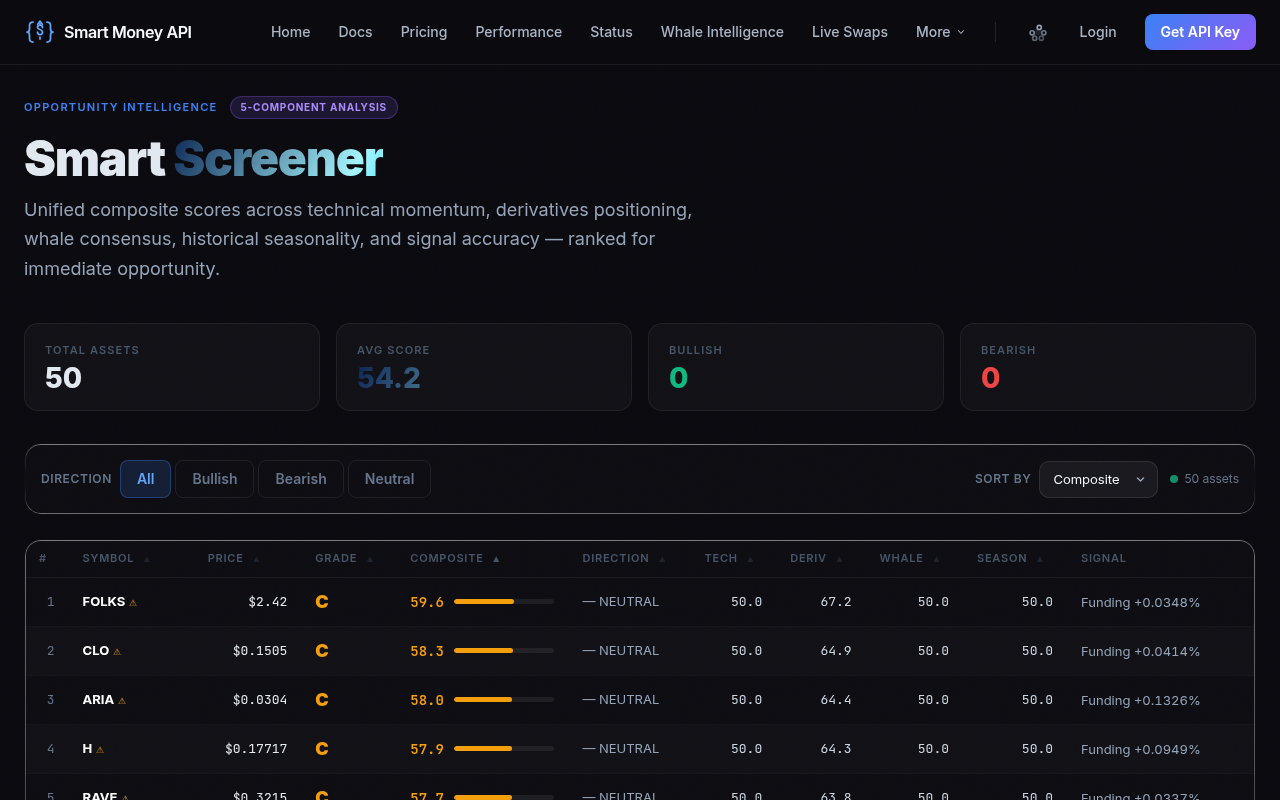
- Set up alerts. Use email, Telegram, or Discord webhooks to notify you when a coin breaks into the top tier or the composite score exceeds 0.75. The Smart Money API's smart screener can also deliver these alerts through its dashboard, saving you the hassle of building a notification stack.
Action Rules: Trade on Rank Changes
A watchlist ranking is only as good as the trade decisions it triggers. Define clear, non‑discretionary action rules to convert rank changes into positions.
- Entry rule. Go long when a coin's composite score rises above 0.70 and its rank improves by at least 3 spots in one day. Confirm the move is supported by increasing OI and neutral funding to avoid unstable conditions. For example, if SOL moves from rank 12 to rank 5 with a composite of 0.82 and funding near 0.01%, that's a strong signal.
- Exit rule. Close the position when the composite falls below 0.50 or the rank drops more than 5 spots. Alternatively, place a trailing stop based on ATR to protect profits. If the entry was on a 0.82 score and three days later the score is 0.48, you exit regardless of P&L.
- Position sizing. Scale capital based on the confidence of the signal. Use a position size calculator to risk no more than 1‑2% of your portfolio per trade. If the Smart Money API returns a `size_mult` (like 1.5), adjust your maximum risk accordingly—multiply your usual risk by that factor to size up on high‑confidence plays.
- Performance tracking. Log every trade, and after 20–30 trades, calculate your ROI using a ROI calculator to see if your multi‑factor watchlist is truly edge‑positive. Refine weights or signal thresholds based on real results.
- Portfolio rebalancing. At the end of each week, re‑assess the watchlist rankings and reallocate capital to the top 5–7 coins, while reducing exposure to those falling in the ranks. This systematically follows the strongest multi‑signal consensus, much like a momentum‑factor ETF.
Conclusion: Build a Living, Breathing Watchlist That Outsmarts the Market
Building a multi-factor crypto watchlist transforms you from a reactive trader chasing pumps into a methodical portfolio manager. By layering derivatives momentum, on‑chain capital flows, and macro sentiment, you create a scoring algorithm that surfaces high‑conviction trades before the crowd notices. Start small—pick 20 coins, weight three signals, and update nightly. Then iterate. For a head start without the heavy lifting, sign up for a free API key from Smart Money API and plug its pre‑built composite scores directly into your watchlist. The market rewards those who prepare; your watchlist is that preparation.