The Problem: Holding Spot Costs Funding on Perp Shorts
If you’ve ever tried to hedge a crypto portfolio by holding spot and shorting perpetual futures, you may have noticed a silent drain on your edge: the funding rate. Perpetual swaps keep their price anchored to the underlying index through periodic funding payments between longs and shorts. When the market is bullish and longs outnumber shorts, the funding rate is positive—meaning shorts pay longs. In a classic spot‑perp hedge, that means you pay a premium every 8 hours just to stay neutral, eroding your margin over time.
Consider a simple example: you hold 1 BTC in spot at $60,000 and short 1 BTC-worth of BTC‑USDT perp on a major exchange. Your delta is zero, so you’re insulated from price swings. But if the funding rate averages 0.01% per 8‑hour window (which is typical in a mild bull trend), you’d pay about 0.03% per day—over a year, that’s nearly 11% of your position value in funding fees. For a supposedly “risk‑free” hedge, that’s a steep cost. Traders who ignore funding rate dynamics inadvertently turn a market‑neutral position into a negative‑carry trade.
Understanding Perpetual Swaps and Funding Rates
Perpetual contracts differ from dated futures. Instead of a settlement date, they use a funding mechanism. Every 8 hours, the contract pays or charges the difference between the mark price and the index price. The funding rate is determined by the premium or discount of the perp versus spot. When the perp trades above spot, the rate is positive (shorts pay longs); when it trades below, it’s negative (longs pay shorts). This rate is the “cost of carry” for the synthetic position. A spot‑perp hedge is essentially a synthetic carry trade, but the direction of the cost depends on the prevailing funding rate.
The Cost of a Simple Spot‑Perp Hedge
In a neutral market, the funding rate might hover near zero, and your hedge costs almost nothing. But in practice, crypto markets exhibit persistent skews—perps often trade above spot due to retail long bias. This means a long spot / short perp position is naturally a funding‑paying position. The cost compounds silently, and many traders don’t account for it until they see their PnL eroding. To build a truly sustainable hedge, you need a setup that avoids this fee or even profits from it. That’s where funding‑rate‑neutral hedging comes in.
The Solution: Neutral Funding‑Rate‑Aware Hedges
A funding‑rate‑neutral hedge is a market‑neutral structure designed to sidestep—and often capture—the funding rate, rather than pay it. The core idea is simple: go long spot and short a perpetual, but only enter the short when the funding rate is either neutral (near zero) or negative. In a negative funding environment, shorts get paid, so your hedge actually generates a yield while keeping you delta neutral. This transforms a cost center into a potential profit center.
This concept is sometimes called a “cash and carry hedge” in reverse, a “perp spot hedge”, or “basis hedging.” Unlike traditional cash‑and‑carry (buy spot, sell futures for a premium), you’re not necessarily capturing a large spot‑futures basis at entry; instead, you’re harvesting the funding spread over time. The beauty of this approach is that it doesn’t require a deep discount on the perp—just a non‑positive funding rate. And with the right tools, you can identify these windows efficiently.
A genuine edge in timing these setups comes from aggregating derivatives data, on‑chain signals, and smart‑money flows. For instance, Smart Money API’s heatmap provides a composite trade‑confirmation score that fuses perp market metrics, whale wallet activity, and macro conditions. Before deploying a funding‑rate‑neutral hedge, scanning this dashboard helps validate whether the market environment genuinely supports a neutral funding outlook—or if a shift is imminent.
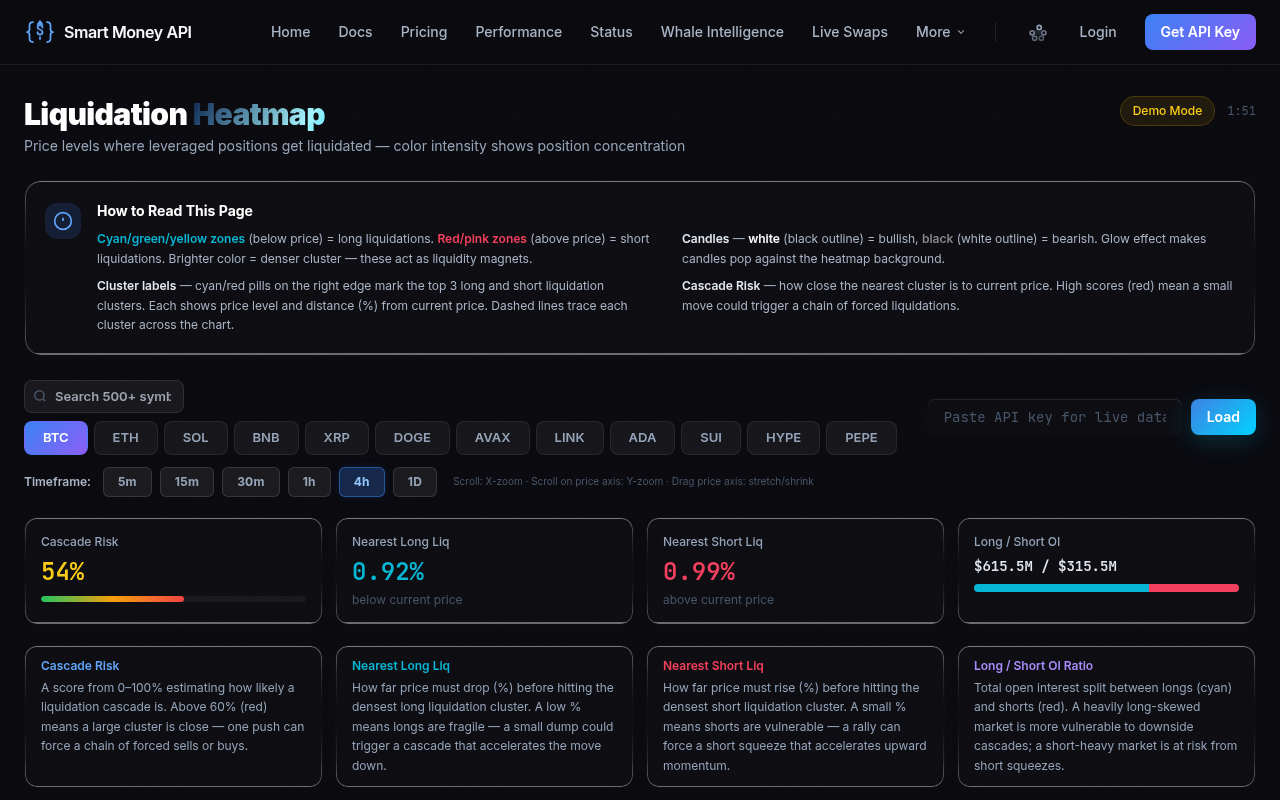
Below, we’ll walk through the exact steps to build and maintain such a hedge, from execution to monitoring.
- Buy spot at the current price.
- Short the corresponding perpetual when funding is neutral or negative.
- Harvest the funding payments as the position runs.
- Size correctly and manage leverage.
- Monitor and rebalance when funding drifts.
Step 1: Buy Spot (Exchange or DeFi), Lock the Price
Before you can short the perp, you need a long spot position that matches the notional exposure you want to hedge. The spot purchase locks in the current market price and provides the synthetic backing for the delta‑neutral structure. Below is a step‑by‑step procedure to do this with minimal slippage and cost.
Choose Your Venue and Asset
- Select an exchange or DeFi platform that offers deep spot liquidity and also lists a perpetual contract on the same asset. Centralized exchanges (Binance, Bybit, OKX) are popular for their tight spreads; however, for self‑custody, you might use a DEX like Uniswap or a lending protocol to acquire spot, then hedge on a CEX with the perp. Be mindful of transfer fees and withdrawal times if splitting venues.
- Determine the asset. The setup works best on highly liquid pairs like BTC, ETH, or SOL where funding rates are actively influenced by market sentiment. Avoid illiquid tokens where funding can be erratic.
- Fund your account. Transfer the base currency (e.g., USDT, USDC) to the spot wallet. Ensure you have enough to buy the desired notional plus a small buffer for fees.
Execute the Spot Purchase
- Place a limit order near the current bid‑ask midpoint to avoid paying the spread. If the market is moving quickly and you want immediate execution, a market order is acceptable, but estimate the slippage first. For a 1 BTC hedge, even a 0.1% slippage is $60—so patience pays.
- Record your exact fill price and quantity. You’ll need this data to match the perp short perfectly later. For example, if you bought 1.2345 BTC at an average price of $59,870, the notional is $73,938. This is the target size for your perp short.
- Move the spot to a secure wallet or keep on exchange depending on your risk tolerance. If you’ll hold the spot on the same exchange as the perp, you can use it as collateral for the margin account (unified margin), simplifying the setup. Otherwise, treat it as a separate pocket.
At this point, you’re long spot. The next step turns it into a market‑neutral position.
Step 2: Short Perp at Neutral or Negative Funding
Here’s where the funding‑rate‑neutral part happens. You’ll open a short perpetual position that exactly offsets your spot exposure, but only when the current funding rate is at or below a threshold you find acceptable. A rate of 0.00% or negative is ideal. Use the CryptoCalcs futures calculator to model your perp position’s liquidation price and funding impact before you commit capital.
Check Funding Conditions
- Pull the current funding rate from your exchange’s API or trading interface. Many platforms also show the predicted next funding rate. Aim for a rate < 0.005% (or zero) per 8‑hour window. Negative rates are a bonus—they’ll pay you from the start.
- Assess market sentiment using a composite score tool. Relying solely on the funding rate can be risky if it’s about to flip. Smart Money API allows you to query a confirmation endpoint that aggregates derivatives, on‑chain, and whale data into one signal. For example, a call like:
GET /v1/confirm?symbol=BTC&direction=long
{
  "composite": 0.74,
  "confidence": "HIGH",
  "action": "CONFIRM",
  "size_mult": 1.5,
  "deriv_score": 0.81,
  "onchain_score": 0.68,
  "whale_score": 0.73
}
Here, a high composite score with a long direction suggests that smart money is leaning bullish, which might imply funding rates could turn positive soon—so you might wait for a more neutral reading or enter cautiously.
Open the Short Perpetual
- Calculate the exact number of contracts. Most perps use a contract multiplier (e.g., 1 contract = 1 USD worth of the asset). Divide your spot notional by the contract value: if your spot is worth $73,938 and each contract is 1 USD, you need 73,938 contracts. If the contract size is in the base asset (e.g., BTC‑USDT inverse contracts), you’d need the equivalent of 1.2345 BTC. Check the exchange’s specifications.
- Choose your leverage carefully. A 1x short on a linear perp requires full margin, but many exchanges allow up to 100x. For a hedge, use the minimum leverage possible to reduce liquidation risk. Excess leverage amplifies funding payments (since funding is calculated on notional, not margin) but introduces unnecessary liquidation thresholds. A 2x or 3x leverage can be safe if you actively manage the margin buffer. The CryptoCalcs leverage calculator helps you find the sweet spot.
- Place a limit order to short the perp at a price close to the current mark. Avoid market orders if the order book is thin. The goal is to get a tight spread so your entry basis is as low as possible. Once filled, confirm your total position is 1x spot long and 1x perp short.
Now your delta is effectively zero—price movements no longer affect your net portfolio value, and you’re set up to either pay zero funding or receive it.
Step 3: Harvest Basis (Funding Spread Over Time)
With the spot‑perp pair active, the funding rate becomes your income stream. This step is about collecting the funding spread that accrues every 8 hours. Over weeks or months, even a tiny negative rate can compound into a meaningful yield.
How Funding Payments Work
On most exchanges, funding payments are calculated as:
Payment = Position Size (in base asset) × Mark Price × Funding Rate
For short positions: if the rate is negative, the absolute value is paid to you. For example, with a 1 BTC short at a mark of $60,000 and a funding rate of -0.01%, you receive 1 × 60,000 × 0.0001 = $6 every 8 hours. Over 30 days, that’s roughly $540—a 0.9% monthly return on the notional, completely uncorrelated to BTC’s price. The table below illustrates different rate scenarios for a $100,000 hedge position.
| Funding Rate (per 8h) | Daily % Received | Monthly Return on Notional | Annual Equivalent |
|---|---|---|---|
| -0.01% | 0.03% | 0.9% | ~11% |
| -0.005% | 0.015% | 0.45% | ~5.5% |
| 0.00% | 0.00% | 0.00% | 0% |
| +0.005% | -0.015% | -0.45% | -5.5% (exit!) |
Practical Steps to Harvest
- Enable funding payment alerts on your exchange app or through a portfolio tracker. Record each payment to ensure you’re being credited correctly.
- Decide whether to compound. If you’re using the same margin account, funding payments are typically settled in the quote currency (USDT, USDC). You can either withdraw them as profit or reinvest them into the position to grow the notional. Reinvesting requires rebalancing the spot side to keep delta neutral, so it’s more complex but can increase yield.
- Track the real‑time funding rate with a tool like Smart Money API’s heatmap. It shows you at a glance whether rates are holding steady or beginning to drift—giving you early warning before your cost flips.
Position Sizing: Match Leverage, Avoid Liquidation Drift
Getting the sizing right is critical. An imbalance between spot and perp leads to residual delta, and over‑leveraging the perp short can trigger liquidation even if the spot value remains constant due to basis volatility. This section provides a concrete sizing routine.
Calculating the 1:1 Hedge
- Spot notional = Quantity × Average entry price. If you own 2.5 ETH at $3,200 each, notional = $8,000.
- Perpetual contract value. For linear contracts (e.g., ETH‑USDT), each contract is typically 0.001 ETH or $1. Use the exchange’s contract spec. Multiply to match the notional exactly. For a $1 contract, you need 8,000 contracts.
- Cross‑check with the CryptoCalcs leverage calculator. Enter your entry price, desired leverage, and wallet balance. It will show you the liquidation price and margin required. Aim for a liquidation price far out of reach (e.g., 50%+ away from the current mark). With low leverage, this is easy.
Setting a Safe Leverage Level
1x to 2x is the optimal range for a funding‑rate hedge. At 1x, you cannot be liquidated unless the exchange enforces a maintenance margin on a spot‑margined position (some do for perps). At 2x, your liquidation price is roughly 50% above your entry (for a short), so only a >50% price spike would threaten it. Since you’re delta neutral, the spot will rise by the same amount, offsetting the perp loss on paper—but your margin account only sees the perp. Always keep a cash buffer in the margin account to cover temporary mark‑spot divergences. A good rule: maintain at least 20% of the position’s notional as extra collateral.
Avoiding Liquidation Drift
Funding rates themselves can cause slight drift. When you receive funding (negative rate), your margin balance increases, improving your margin ratio. If the rate turns positive, your balance decreases, edging you closer to liquidation. Regular rebalancing—as discussed next—prevents surprises.
Monitoring: Rebalance When Funding Drifts Over Threshold
No hedge is truly set‑and‑forget. Funding rates are dynamic, and a once‑neutral setup can become costly if market sentiment changes. Your ongoing job is to monitor the funding rate and rebalance (or exit) when it crosses a predefined threshold.
Set a Trigger Threshold
- Choose a maximum acceptable funding rate. For a true neutral hedge, even a small positive rate (e.g., +0.003% per 8h) might be tolerable if you’re earning on the spread elsewhere, but for a pure harvesting strategy, the threshold should be near zero. A common rule: exit if the rate exceeds +0.005% for two consecutive 8‑hour windows.
- Use automation or alerts. Most exchanges allow you to set price alerts, but not always funding alerts. Third‑party tools—including Smart Money API’s composite signals—can notify you when the funding environment shifts. Their heatmap displays aggregate market conditions, so you see the big picture.
Rebalancing Actions
When the breach occurs, you have three options:
- Close the entire position. Sell the spot and buy back the perp short simultaneously. This locks in any spot‑perp basis profit/loss and stops future funding costs. This is the cleanest exit.
- Partial hedge. If you still want some exposure, reduce the perp short proportionally—but this introduces delta, so it’s no longer market neutral.
- Wait and add a buffer. If you expect the funding spike to be temporary (e.g., a futures‑led pump), you can add margin to your perp short to sustain a few more funding cycles. Only do this if you have a strong conviction and the cost is minimal.
Rebalancing should be systematic. A simple checklist: every 8 hours at the funding timestamp, check the actual rate. If it’s above threshold for two consecutive marks, execute your exit plan. Document each adjustment to refine your strategy over time.
Build Your Funding‑Smart Hedge Today
Funding‑rate‑neutral hedges turn a perennial crypto cost into a reliable yield strategy. By pairing spot with a perp short only when the funding rate works in your favor, you maintain a zero‑delta portfolio while collecting a steady income stream. The key is in the execution: precise sizing, low leverage, and vigilant monitoring. Integrate tools like the CryptoCalcs futures calculator for perp modeling and the leverage calculator for margin safety. Then, overlay a market intelligence layer: sign up for a free API key from Smart Money API to access the same heatmap and composite trade‑confirmation scores that institutional traders rely on. With 62% win rates on HIGH signals and a fusion of derivatives, on‑chain, and whale data, you can time your hedges with greater confidence. Stop paying unnecessary funding—start earning it.